Osh was the place I headed towards from Andijan, Uzbekistan. (Andijan is the home to the Chrysler car plant in Uzbekistan – no wonder everyone drives a Chrysler.) The large group of Bokhara men who had arrived on the same train was going through Kyrgyzstan to Irkutsk, Russia, to work for Gazprom. It was going to be a busy border crossing. =
Osh is in the foothills of the Tian Shen mountain range: an ancient town that marked the halfway point between Europe and Asia on the Silk Road. It must have been a relief to come safely through the high passes into the Fergana Valley, one of the most fertile places on earth. The Suleyman (Solomon) Mountain above the town is a series of crags rising steeply from the floor of the valley. The story is that the Muslim prophet Suleyman’s grave is here; there is a small mosque and many Muslims make a pilgrimage to it. It is also a beautiful spot from which to view the the town and the valley beyond.
A woman overtook me, smiling, on the climb up to the top of the Suleyman Mountain; there she was again, lying on the stone which is said to have magical qualities and certain wishes to come true if you slide down it. I was not going to miss that, so I asked if I could have a go – and it was the beginning of a new friendship. Akkuu (it means White Swan in Kyrgyz) lives in Bishkek but was in Osh visiting her husband’s family. We spent the rest of the day together, had dinner in an Italian restaurant and got to see a comedy show with music in the Grand Theatre (half of it, my Kyrgyz being nil). The next day, with the help of her aunt-by-marriage, Chalpon (of whom more later), we took a trip out to a beautiful waterfall, Abshyr Ata – another place of pilgrimage.
Auntie Chalpon, AkkuuThe cave opposite the waterfallThe climb up to the waterfall – icy and prettyThe canyon into the tian-Shen mountains
Rasul, the owner of the Eco House hotel where I stayed, came up trumps: I’d asked if he knew where I might be able to see KOK BORU, also known as ULAK, the horse-mounted sport (the forefather of polo) played in several Central Asian countries.(I had tried to find a game before, all without success. It looks like you need to know someone who knows someone who is in the game, either as a participant or a sponsor. (Considering how many people were at the game, and many coming from a long way off – we saw a number of lorries transporting horses on the road – the word of mouth is strong.) Nookat is a provincial, agricultural town, some 50 miles from Osh. Winter is the time when KOK BORU is played in villages, when there isn’t much work to be done in the fields. Having only read about the game in the guide book, I wasn’t sure what to expect. My guide, (also Rasul) was a former policeman, a former customs officer and a current teacher of Russian; also a farmer, a former KOK BORU player (and probably a few other things he had not mentioned). We were driven by Temir, Rasul’s friend, in a Lexus (higher off the ground then the Lada we started off in, needed on the country roads).
uGoing to take part in the kok boruA prize Rasul, my guide
The first view of what I had come to see was a far-off long, dark, shifting stain on the white snow of the wide plain. As we got closer, the movement became clearer and then one could see individual riders within the melee. The whole moved like a swarm, the riders (both players and spectators) following the key man, the one with the goat’s carcass tucked on his saddle. His aim was to get the goat to the truck which served as a goal, a royal box, a commentary box and a drone control centre. (I had been hoisted onto the truck pretty fast as the space in front of it was suddenly overrun by horses – Rasul took his responsibility for looking after me very seriously, and I was glad to be out of the way.)
The game in progressOne of the spare goat carcasesThe compere – a local manOne of the winners – just delivered the carcass
The Kyrgyz say they are “born in the saddle” – they virtually learn to ride before they can walk. Looking at the way horses and riders seemed to be one here proved the point. The game has been used to train the horses (and riders) to be fearless in battle. Women are not present (I was the only female there). Between each bout there were dedications, prayers, a bit of entertainment in the form of a dombra player and singer; when he played a well-known humorous song, money was tucked under his hat. The game keeps on being played until all the prizes have been given out. (Any rich person can sponsor a game and provide the prizes. Players will come.) On this occasion, there were some 30-40 colts, several camels, money, a car.
The dombra player, wearing a kalpak (Kyrgyz felt hat)
Took a taxi from Samarkand, Uzbekistan to the Tajikistan border – an easy, straightforward crossing. Panjakent, Tajikistan, is a provincial town that would be no different to any other, were it not for two important archeological sites: the ancient Panjakent that was a flourishing Sogdian town (by now, the names of various khanates, emirates, empires and kingdoms do roll off the tongue) in V-VIII centuries (until the Arab invasion); and Sarezm, which “dates back to the 4th millennium BC and is today a UNESCOWorld Heritage Site“. Ancient Panjakent was abandoned suddenly (in the face of fierce attacks) and never rebuilt – some therefore call it the Pompeii of Central Asia. (Most of the best preserved and important items have been taken to the Hermitage by the Soviet archeologists who worked the site in the 60’s andd70s. A few items are in the Dushanbe National Museum.) I climbed the two hills old Panjakent was built on and even my imagination had difficulty seeing it in its heyday. Sarezm is “of great interest for archaeologists as it constitutes the first proto-historical agricultural society in this region of Central Asia” (Wiki).
A few reconstructed walls at Panjakent ancient siteAncient PanjakentSarezm -5000 years of historyThe most intriguing space in SarezmZoroastrian followers – a fire in the middle of every area
But the trip to the Seven Lakes (HAFT KUL in Tajik) in the foothills of the Pamir range was terrific (and terrifying): Rohim, the taxi driver, owns a Mercedes automatic (with summer tyres) just fine for dry, asphalt roads. The road to the lakes is a narrow, rough, unpaved snake, strewn with stones fallen from the sheer mountain sides, riddled with potholes and having bite-shaped chinks missing on the steep slope to the lake side. There was also snow, and on one hairpin bend Rohim had five goes before making it over the icy bit. The road goes along the canyon of the river Shing. There is a gold mine and an ore processing plant a third of the way up – there was a lot of dust on the way – and silt and waste from the processing go into the river. Higher up though, the water is pristinely clean. (We took with us a dozen or so plastic gallon containers to bring back fresh water from the top lake for Hajji, my host.)
The gold mine nearbyGoing homeCliffs to one side, drop the other
The first lake is called Eyelash, because of its shape; the second is Soja – Shady; the third is Gusher – Nimble; the forth is Nofin – belly button; the fifth is Churdak – Small; the sixth is Marguzor – Blossoming Place; the seventh is Hazorchasma – a 1000 springs.
Life in the mountains has a different, much slower pace. Yes, there are satellite dishes and mobile phones, but laundry is still done by the lake, the most reliable transport is by donkey, and visitors are still interesting enough for the children to gather and watch.
I took the shared taxi to Dushanbe – a little more expensive than the marshrutka minibus but much more comfortable. Hajji, the owner of the hotel where I stayed, organised for the taxi to pick me up at the hotel and Hajji made sure I got the front seat, so no squeezing in the back (and it was a squeeze: 3 people and a baby.) It is a 3,5 hour journey on a good road through spectacular mountain and canyon scenery along the Zarafshan river.
Dushanbe is a young capital. There is little to see from before the beginning of the 1930’s – the town is all Soviet central planning snd building – and nowadays they are getting rid of some of the heavy Soviet constructions. There are many parks, squares and fountains (though all water features were wrapped up against the frost). And plenty of sculptures and monuments: every town has the statue of Ismaili Somoni, the 10th century emir, seen as the father of the Tajik nation; and the poet Rudaki is honoured in statue and park and street names.
The forever president of Tadjikistan on every buildingIsmaili SomoniThe president and the future president (his son, currently the mayor of Dushanbe)Rudaki
The electronic display outside the Ayni Opera House advertised Tchaikovsky’s Idomeneo among other things and I thought, yippee! The lady in the booking office was very sorry, but the opera had been cancelled (no reason given). But I could go and see a musical drama for children the next morning… so I did. The Rabbit with His Nose in the Air (in Russian) was a (cautionary?) tale of the downtrodden and frightened animals who manage to outwit the ruler Lion (who wants to eat one of them). Thought there may have been a subtle lesson in it to teach the children how to get rid of dictators… The music ranged from Enio Moricone’s The Good, the Bad and the Ugly to the Sugar Plum Fairy. The theatre is a nice neoclassical building from the 1940s. Not far from the Ayni Opera House is the National Museum of Antiquities where the pride of place goes to the Sleeping Buddha, at 16m the largest statue of him in the world (since the destruction of the Bamiyan Buddhas in 2001). Lots of other interesting exhibits, but not many of them have an explanation in English (and even Russian was scant). I found the polystyrene pieces holding parts of antiquities up odd – as if temporary has become permanent.
The foyer of the Ayni OperaThe primary school children seemed to enjoy the showIt rained incessantly for two days in DushanbeNOT a gym weight but a grain grounderThink they are grave stone inscriptions – in Kufi, Arabic, PersianA X ct reconstructed piece of ornamental decor
Left Dushanbe in the rain to fly to Khujand (near the Uzbekistan border, as I needed to dip into Uzbekistan to get to Kyrgyzstan – the land border crossings between Tajikistan and Kyrgyzstan are not open to foreigners as yet). Khujand welcomed us with snow – though the locals kept saying “it never snows here”… The bazaar is, as always, a place of colour and movement, hawking and fascination.
Arbob Cultural palace is a wonderful oxymoron: built in the early 1950s, to be used by the workers of the kolkhoz/sovhoz as a place for meetings and entertainment, it is based on the tsarist Winter Palace in St Petersburg. The driving force behind the construction was a local Tajik, Urukhoajev, the leader of the collective farm and a member of the Soviet leadership in the area (it seems even Stalin respected him – when the order had been given that everyone had to wear a military uniform to Soviet meetings, Urukhoajev was permitted to wear the traditional Tajik clothes). The palace has been built with local labour and local artisans did all the decorating – from woodcarving to painting intricate designs on ceiling panels, to stone and plasterwork statuary. It is now a museum, but also used for special state occasions – and for wedding photos.
I spent a day in Margilan, Fergana Valley, THE silk town in Uzbekistan. The town is synonymous with silk production – the Yodgorlik silk factory still uses traditional hand-weaving method for some of its products, and it is fascinating to watch the women work (women weave, men dye the silk thread). The Institute for the Research of Natural Fibres showed me around too – they investigate and test which mulberry trees (and there are quite a few varieties) produce the best leaves-food for the silkworm, and through selection and feeding of worms work out which produce the best and longest thread – some cocoons will have more than 2000m of silk thread.
The feet dance the pattern, the hands firm the weaveThe various cocoons from various mulberry treesRaw silk
Getting the ticket for the train from Margilan to Andijan (a 45 min journey), close to the Kyrgyzstan border, was a lesson in patience. I inadvertently got to the ticket office at 13:40, so it was closed for lunch (a lot of public service places close for lunch between 13:00-14:00 in these parts). Went and had a cup of tea and got there soon after 14:00. The queue (a loose term) seemed long and it was a nice day, so I went for a walk. By 14:30 the queue had not changed much (still the same 5 people) but I thought I’d give it a go. By 15:00 I could ask for a ticket, only to be told that it was a local train, leaving at 07:00 and to come buy the ticket in the morning before I got on… Managed to persuade him that he could issue me a ticket as I was there.
The Margilan railway ticket officeThe ceiling at the train stationsThe bread all looks lovely – and like the ceilingThe tourist office in the railway station – not sure when it was last openThe overnight train from Bokhara to AndijanThe wagon was full of men from Bokhara going to work for Gazprom in Irkutsk
(The process to enter Turkmenistan started well before I left the UK – one cannot visit the country without a Letter of Invitation (LOI), usually provided by a travel agency which then also organises the visit in full. The letter is valid for a month and the transit visa gives you 6 days within that month. The trip is not cheap, especially if it is for one person, as in my case. Owadan Travel is a government approved agency and Saray, the lady with whom I dealt online, has kept me informed throughout. I was initially taken aback when I was told that they would only accept cash payment (in crisp $ notes) . Carrying $2500 – $3000 in cash around Central Asia for months was not an option. On arrival in Ashgabat, my guide took me to the Central Bank to get the cash. I visited their offices and met the owner and members of staff, was shown their little ethnographic museum and given a small present.)
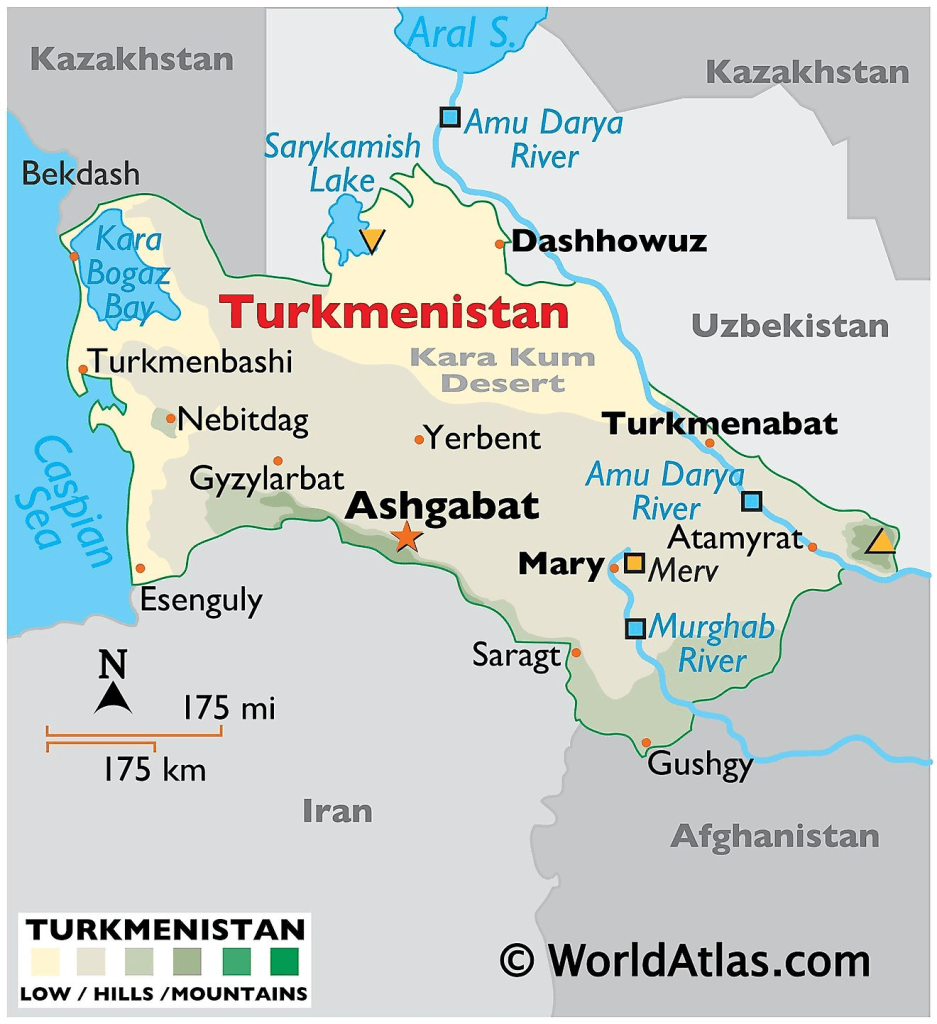
There are no direct flights from Baku, Azerbaijan, to Ashgabat and the Caspian sea port at Turkmenbashi is closed to tourists. Thus, a change of plan and “doing” Uzbekistan first, so I could use the land border crossings. The crossing at Shavat (Uzbekistan side, not far from Khiva) wasn’t very busy at 09:30 am (it is open from 09:00 – 17:00). Just a dozen of us, with me the only non-local – and once the passport was stamped and the luggage put through the scanner, I could walk towards the no man’s land. Beyond the Uzbekistan border fence there was an old commuter type bus, battered, mauled and scarred, likely from the Soviet times, but I was truly grateful that I wouldn’t have to walk the mile or so to the Turkmenistan border fence with my luggage on my back.
The very young Turkmen soldier (military service is obligatory for men at 18; they can defer it if they go to university but need to do it after) took my passport and the LOI and passed it on to someone else… It took about an hour, some 8 people, including my guide (who was called by one of the 8), a doctor (to do a $33 PCR test), various small window counters, old technology, various bits of paperwork, the payment… and I could finally put my luggage on the scanner. Having read about people’s bags being searched to the last pocket and seam, it was a pleasant surprise when the officer said “welcome to Turkmenistan” and asked, smiling, if I smoked, had any codeine based drugs or heroin.
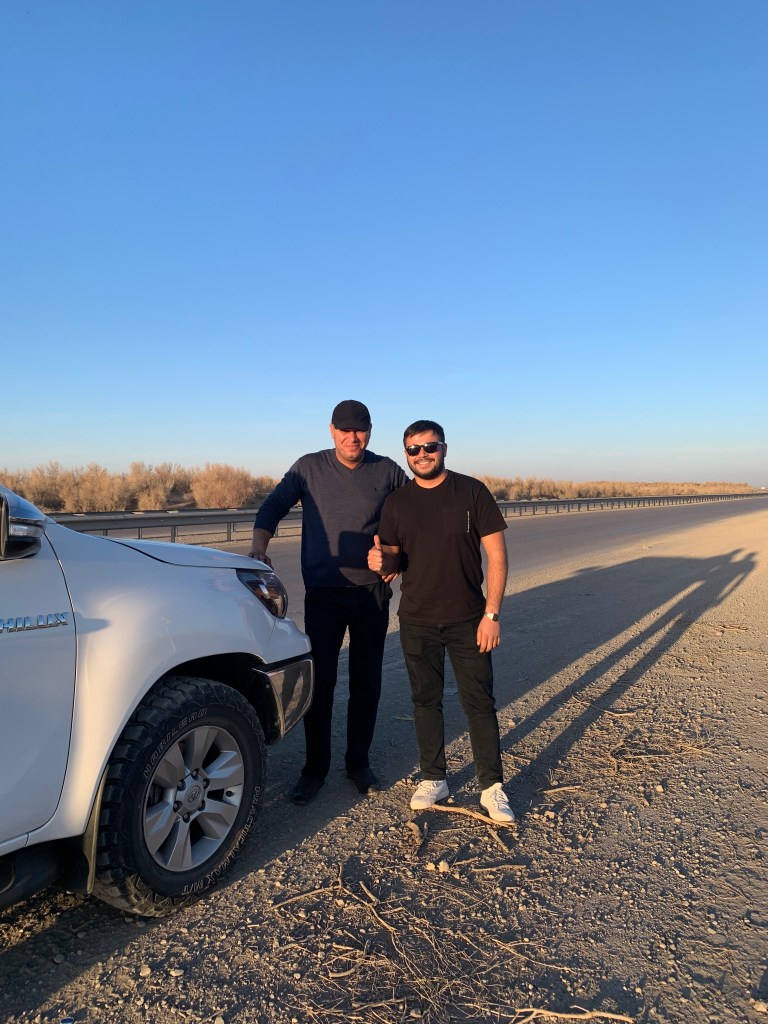
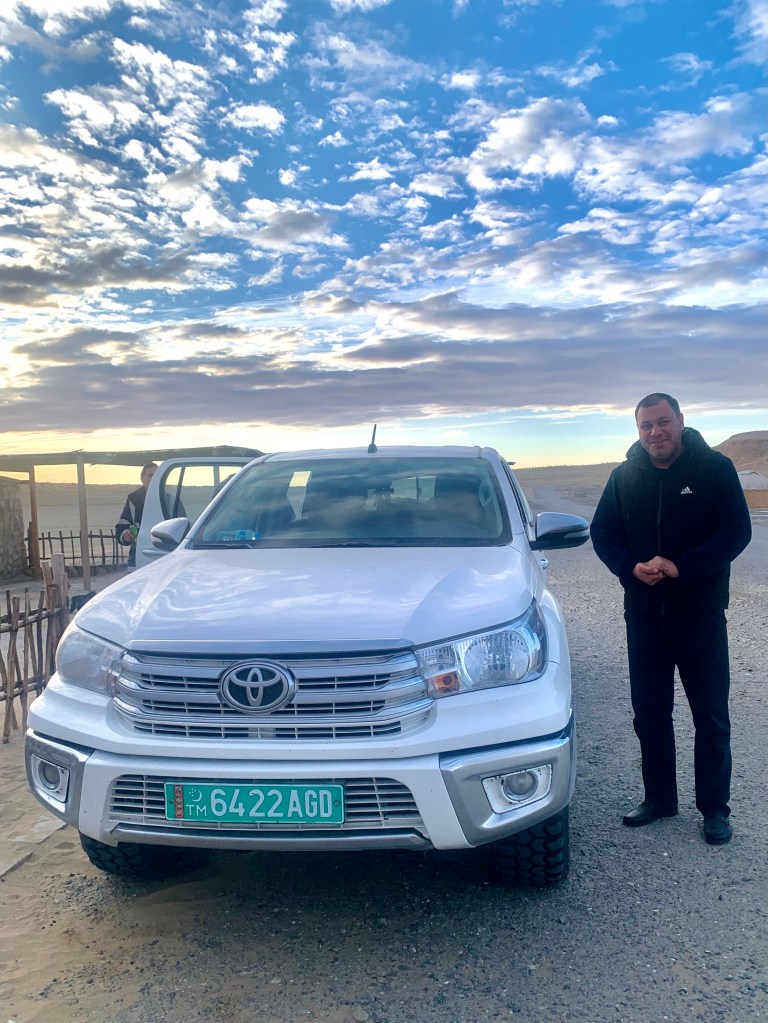
Mekan, the Owadan Travel guide, is a 25 year old English language and literature graduate (studied in Turkey) who can guide in English, Russian and Turkish. Guwanch, the driver of the gleaming white Toyota Hilux, looked a little apprehensive when I usurped the front seat – until he realised I spoke Russian – he then visibly relaxed. He is a good and conscientious driver (seatbelt on at all times!) and we got on very well. (I called him “my hero”, after a particularly scary road bit was negotiated with panache, and he remained “Мой герой” (Russian for ‘my hero’) throughout. I was presented with a lovely box of chocolates by him – he did say this was the first time he ever bought anything for a tourist.
Guwanch and Mekan and the trusty Hilux
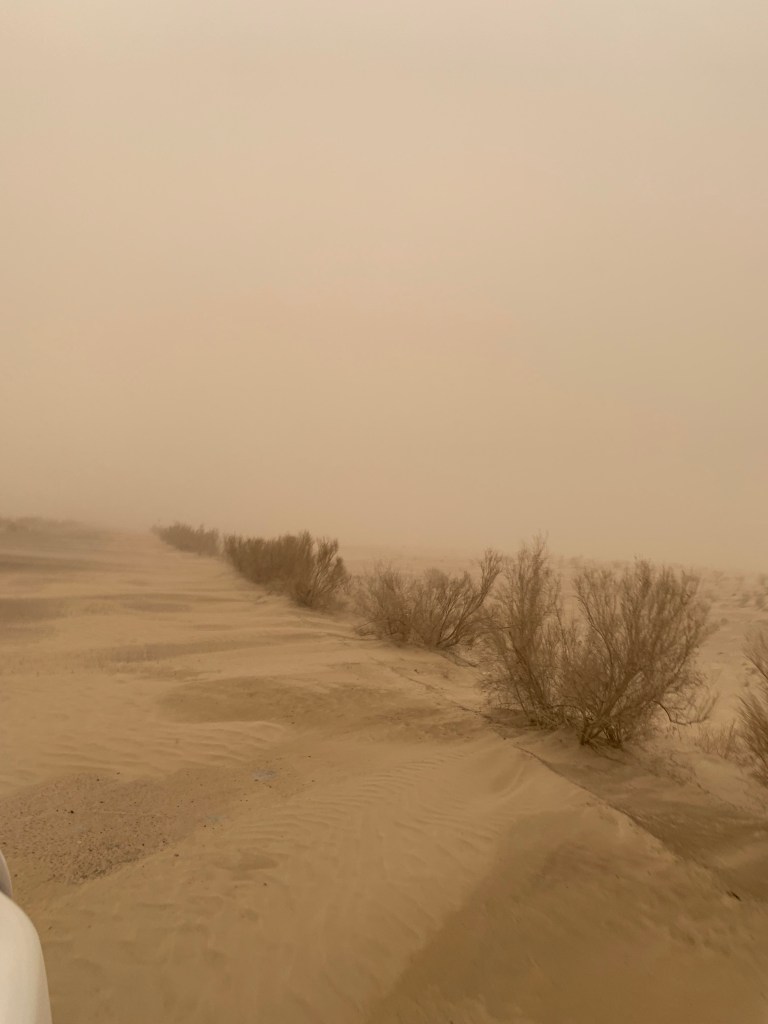
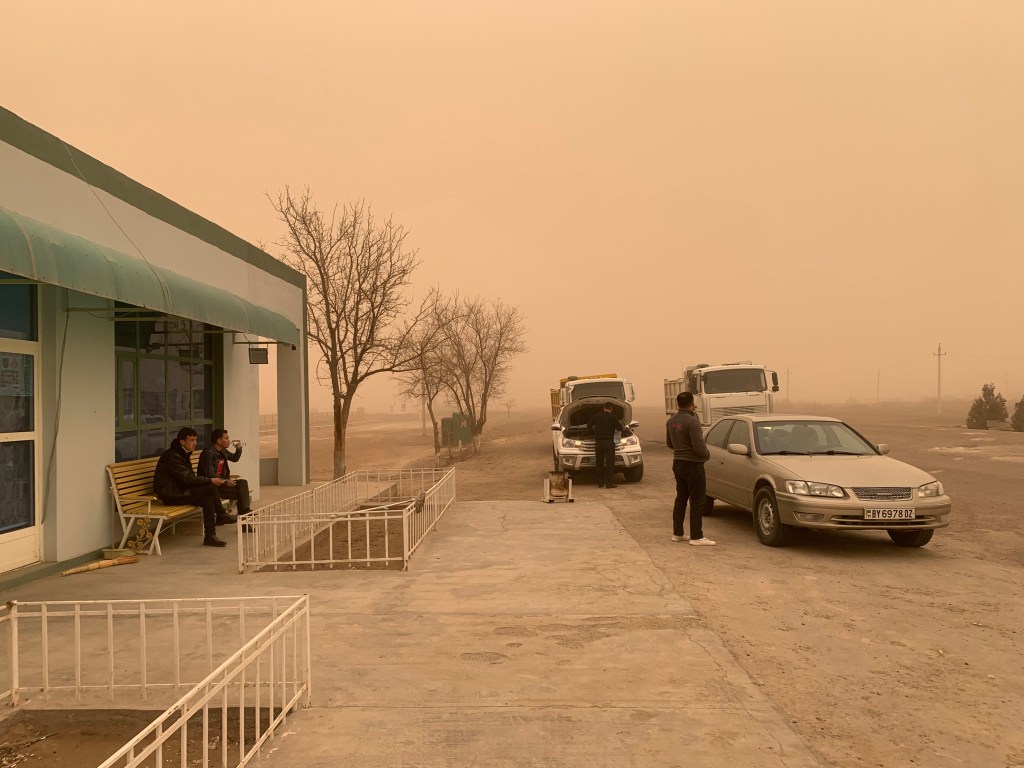
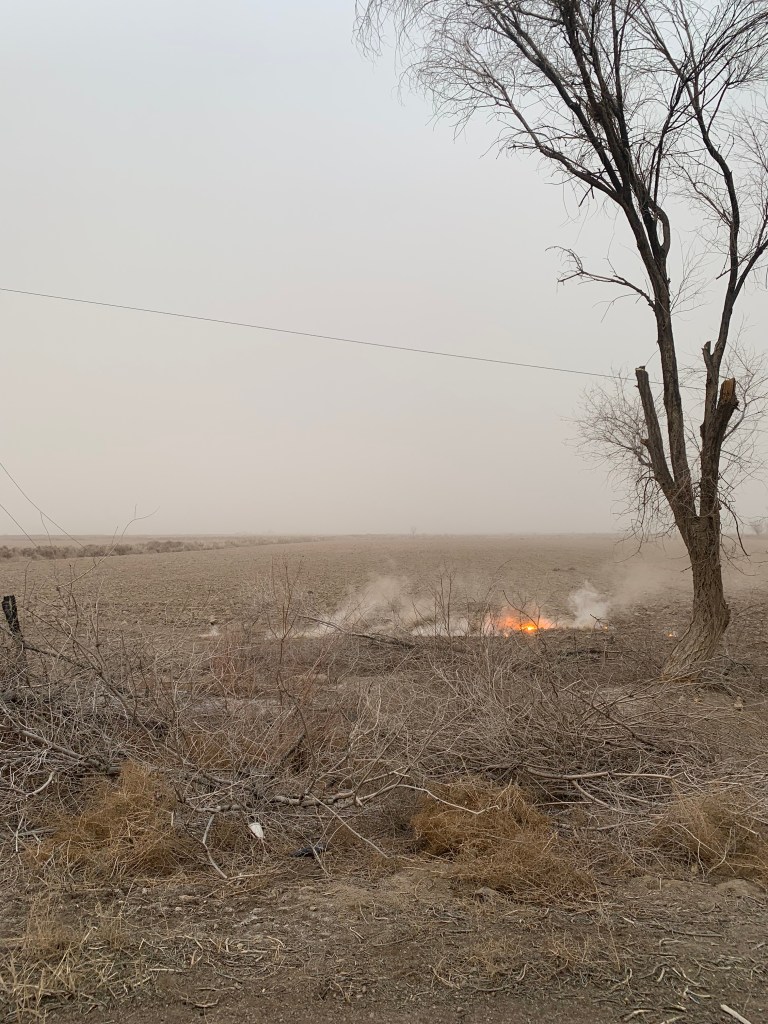
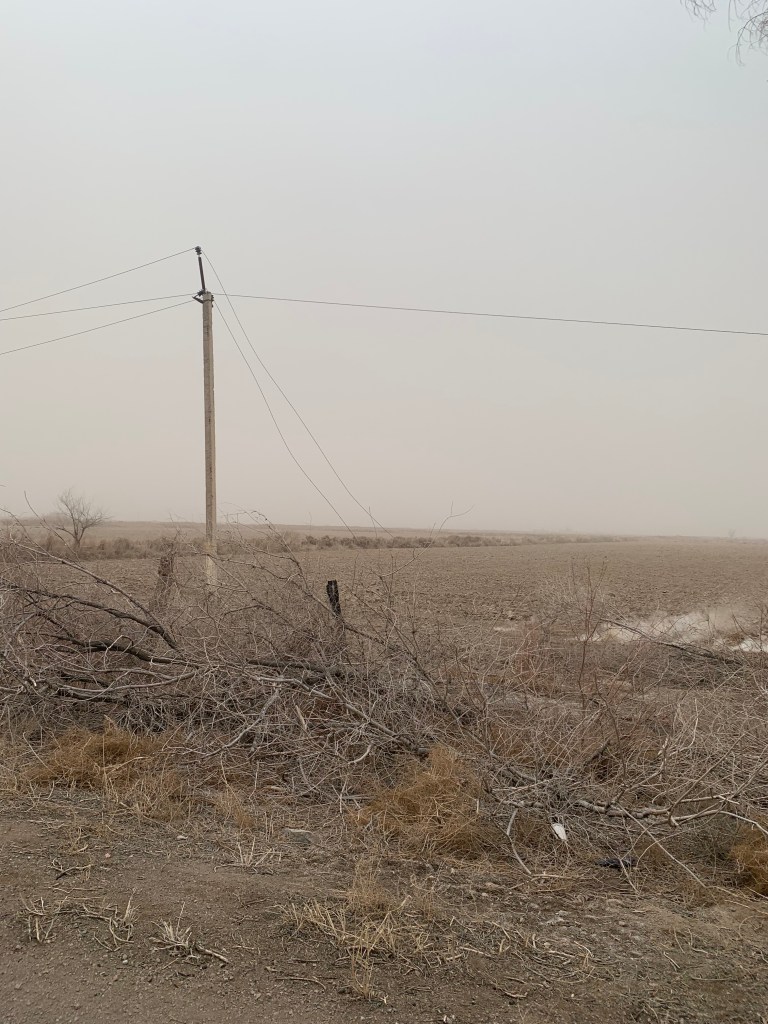
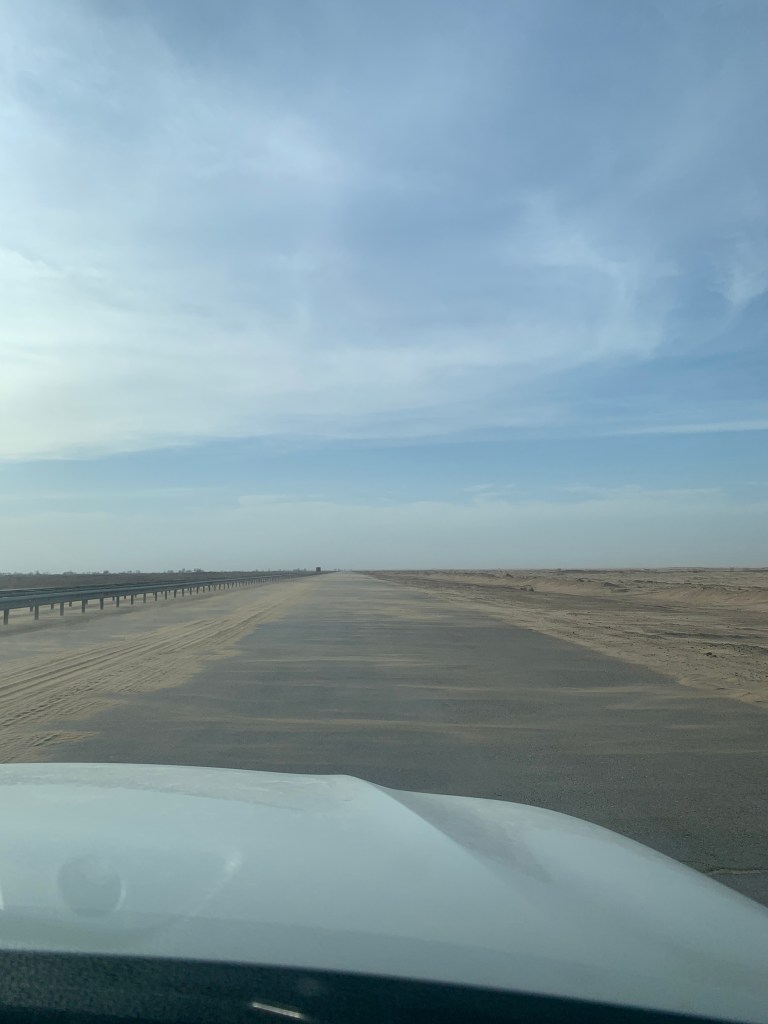
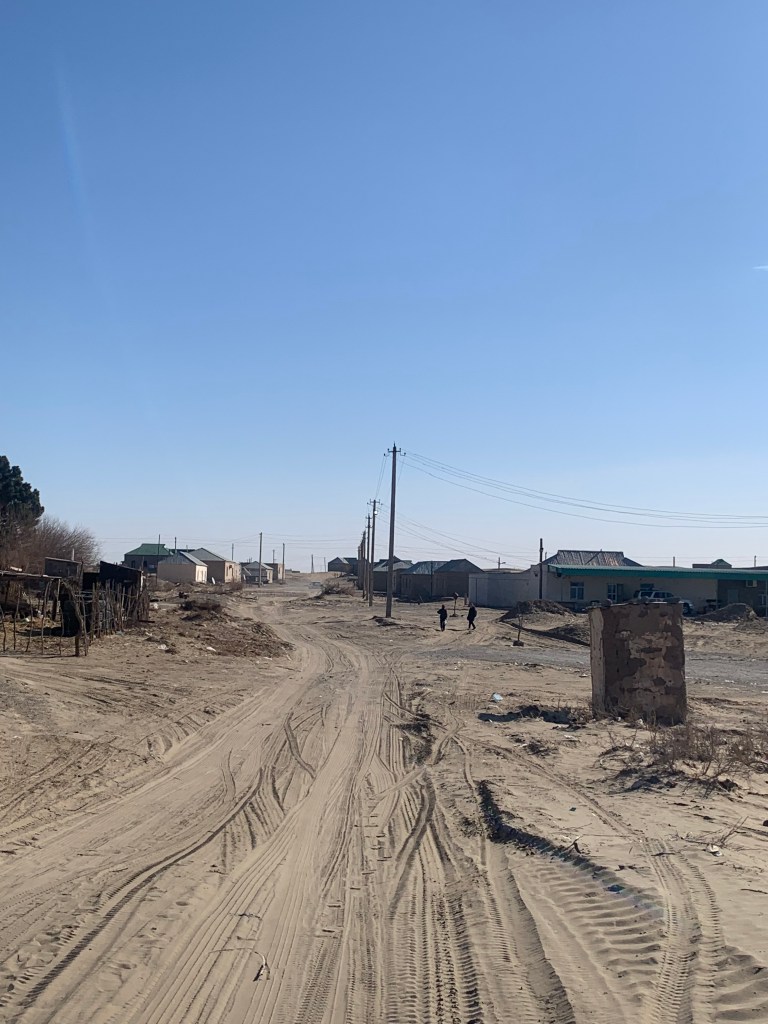
The roads are abysmal. Rutted, potholed, scraped, ploughed, furrowed, scarred, disappeared. The dual carriageway (not always dual) was used on both sides in both directions as each driver tried to find the least damaged bit to drive over. We drove on the right and on the left, overtook on any side, went off road when that was the least awful part. Guwanch manoeuvred the 4-wheel drive Toyota Hilux with (new) heavy duty winter tyres with skill and panache – he had a schedule to keep (to get me to all the places on the programme – we did 310 km on the first day). That day, the wind was up, the sand carried across the road in gusts as blinding as a sudden fog. We saw a tree brought down by the wind that crashed onto the electric wires and broke them – it looked like the ground was burning and Mekan called the provincial fire brigade to tell them about it.
My hero – Guwanch and his HiluxThe last supply shop and loo for 100+km across the desert
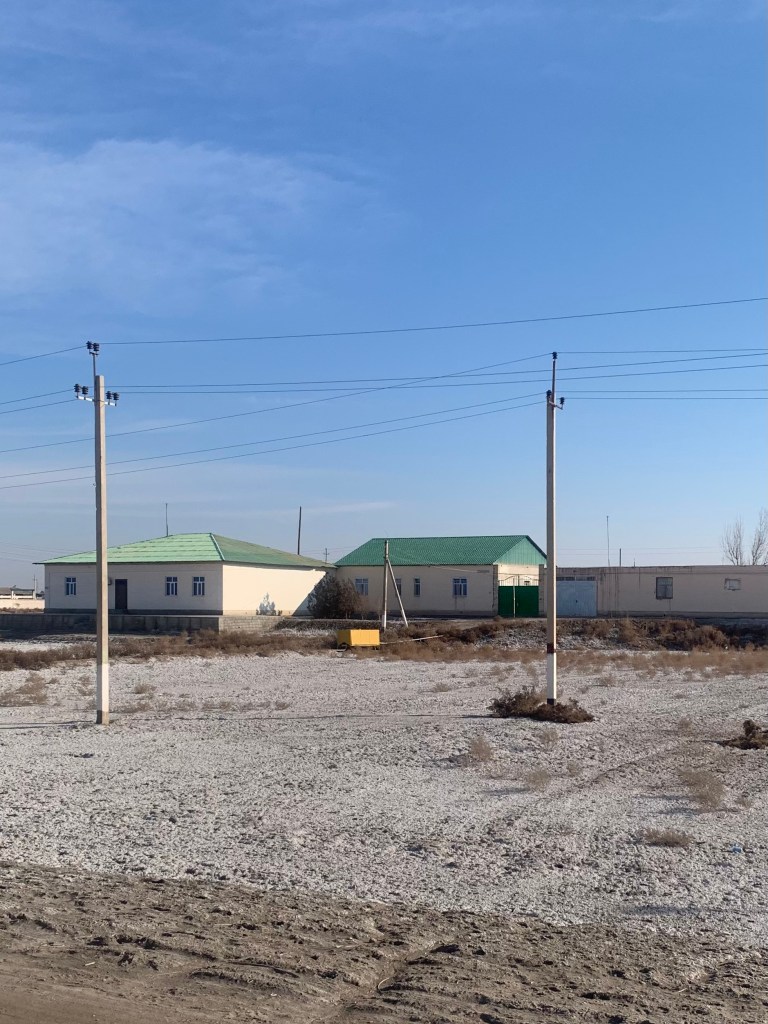
Turkmenistan is 80% desert; its riches, the natural gas, the minerals, ore, are all underground. The soil is salty. I thought at first it was hoarfrost on the ground (also in Uzbekistan) – it is salt. They do grow excellent fruit and vegetables in the areas near the water – melons and cantaloupes are especially highly rated.
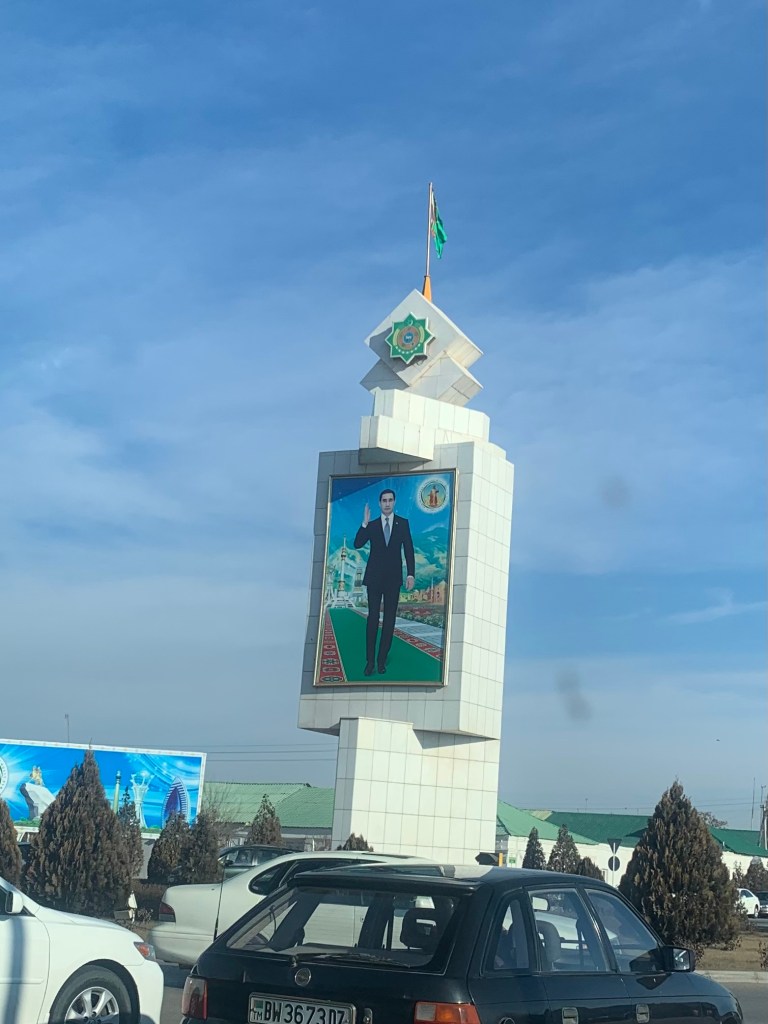
Salt appears as water evaporatesWelcome by the President in Dashoguz
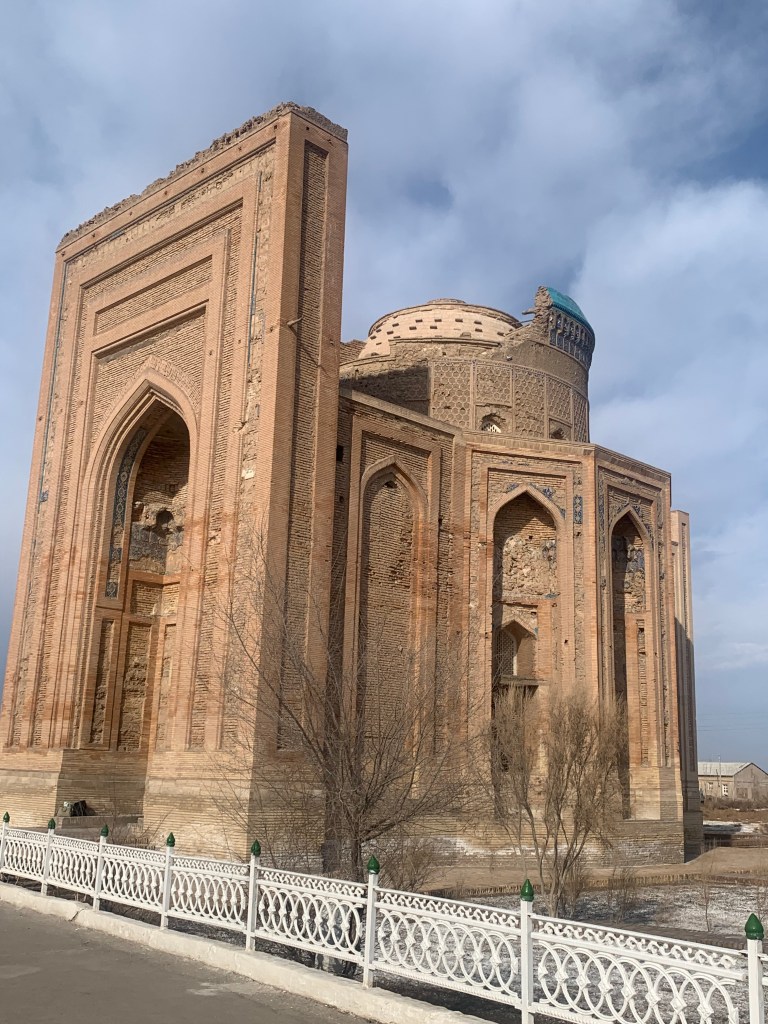
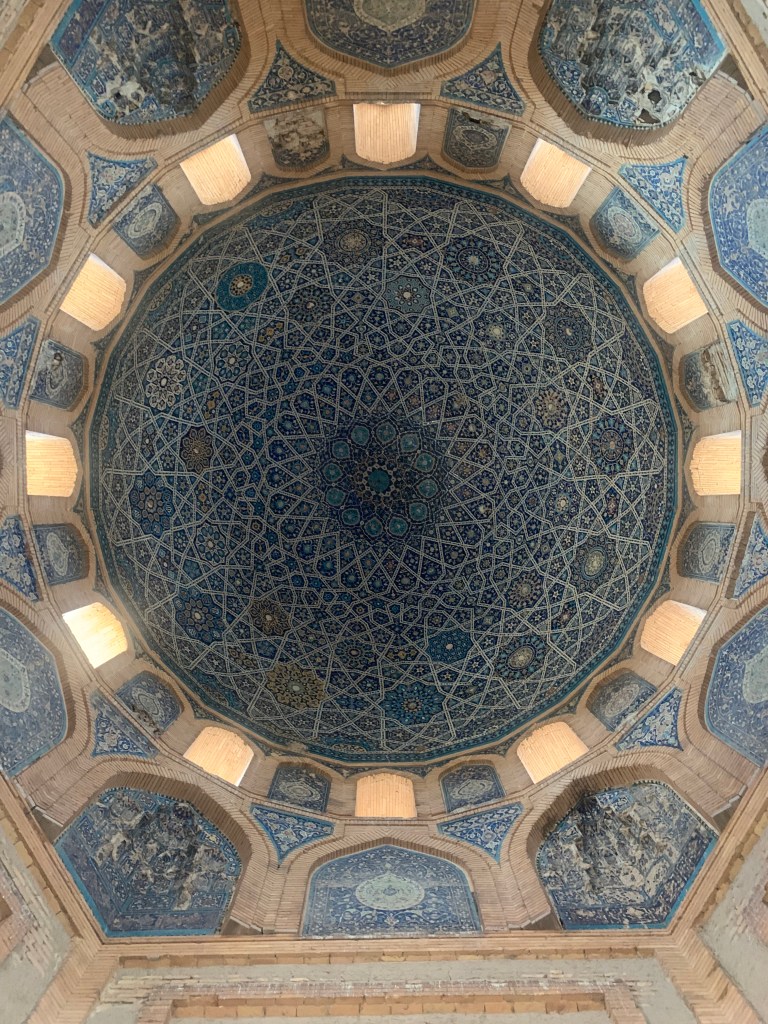
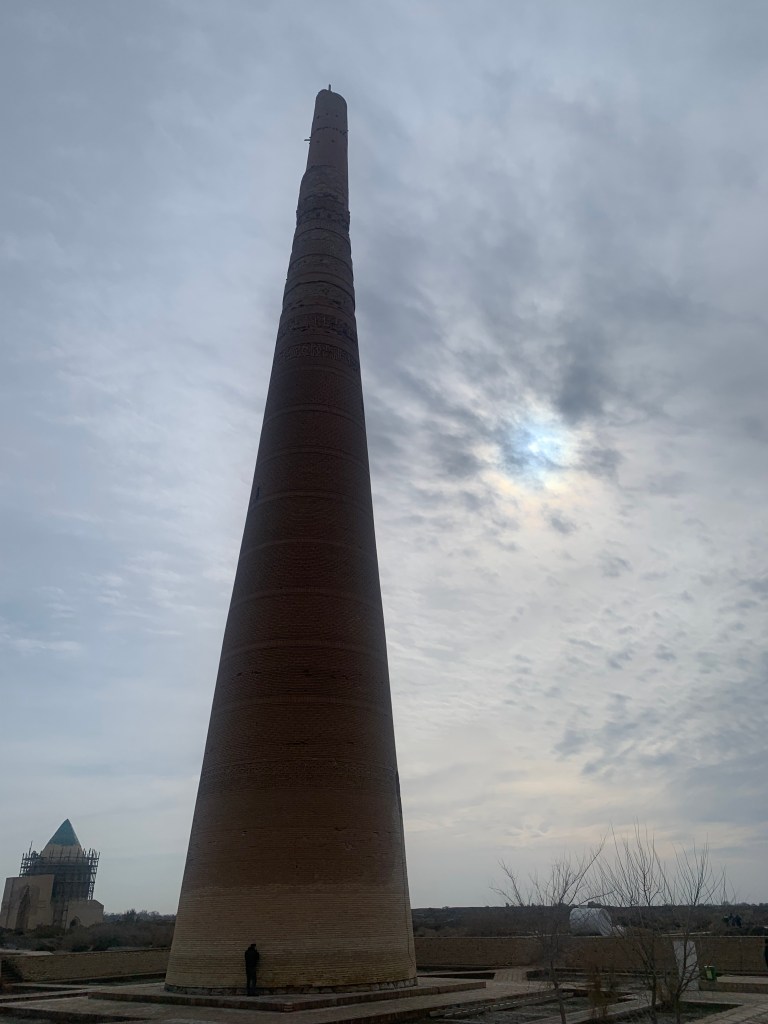
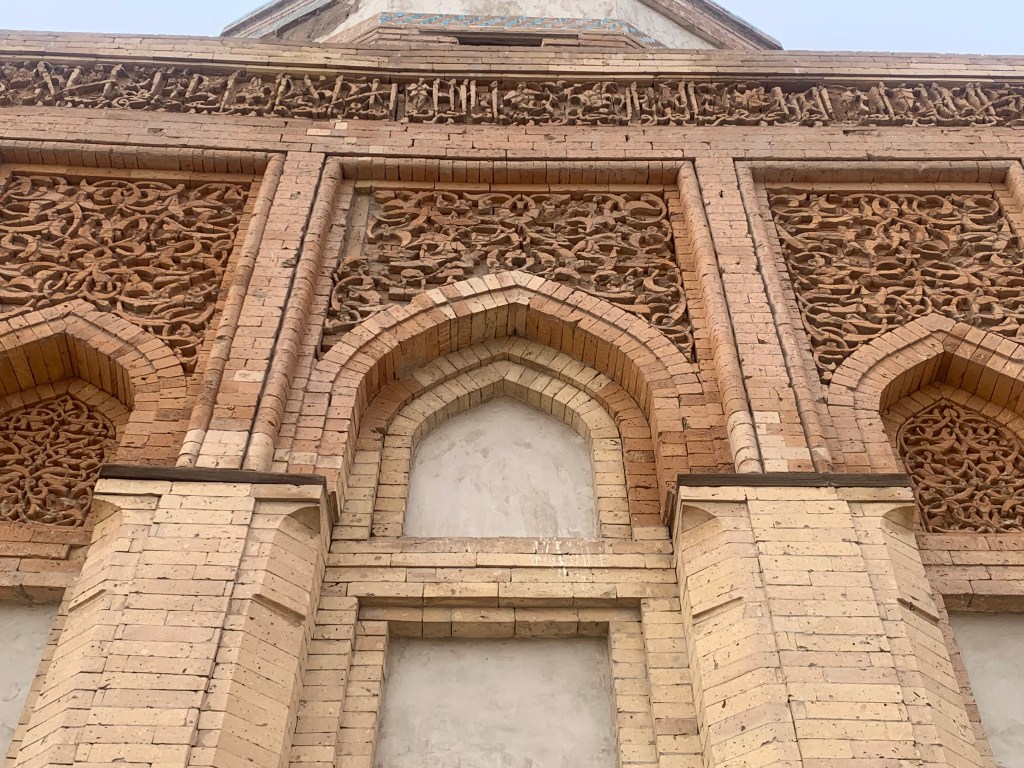
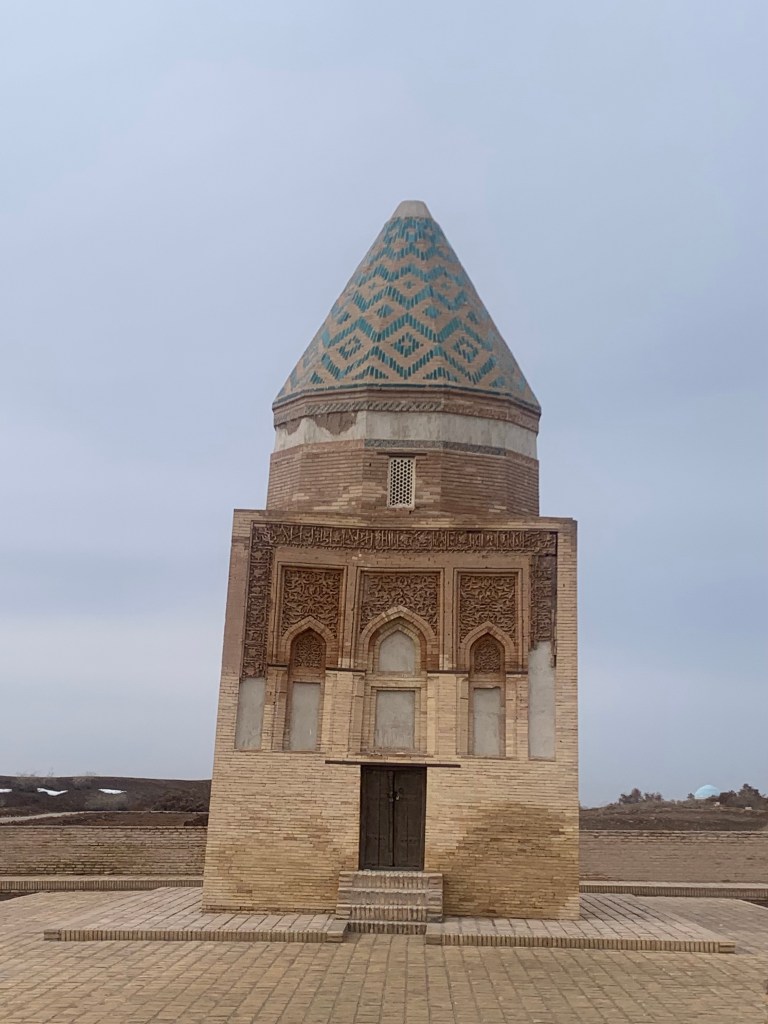
We headed to the first historic place on our sightseeing tour - Konyeurgench. It has a long history, starting in the 5 ct BC, but its heyday was between 11-14 ct when it was the capital of the Kwarezm empire and an important, rich, well developed town on the Silk Road. (Of course, it got raided and sacked and rebuilt several times.) It is now a UNESCO site.
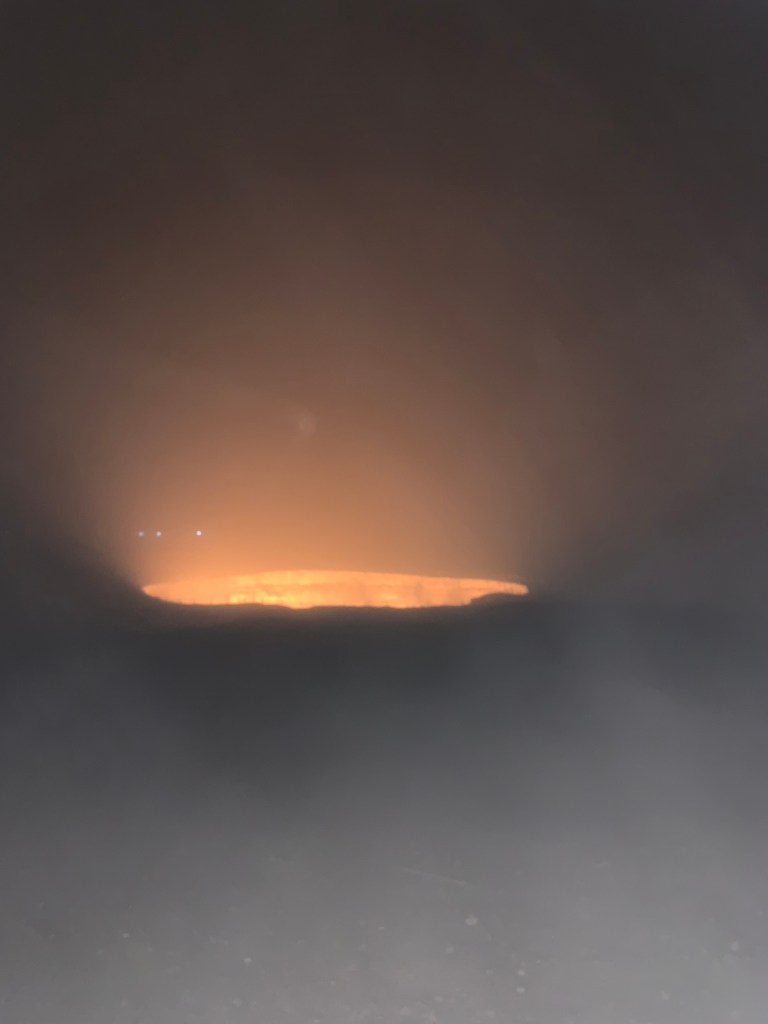
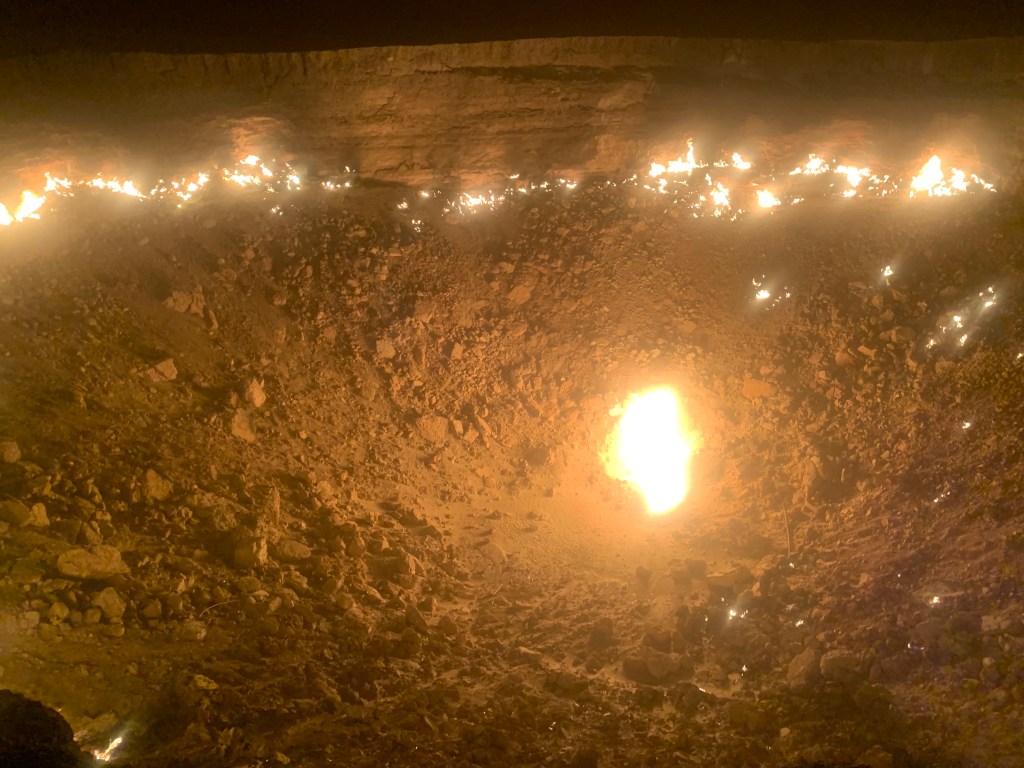
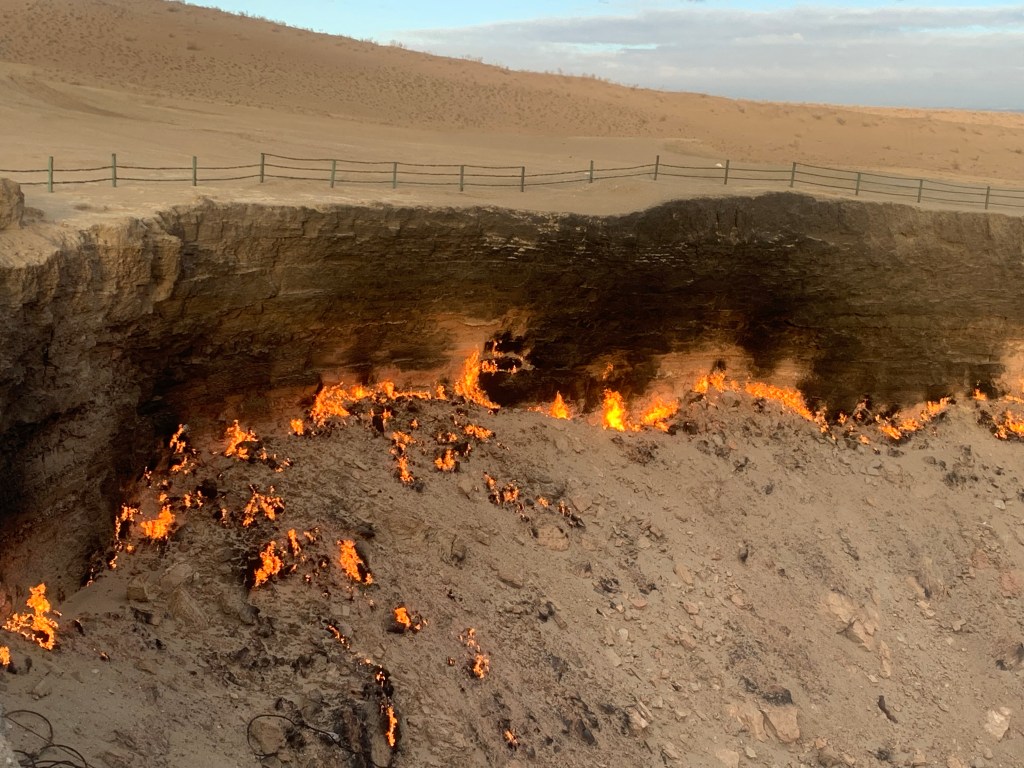
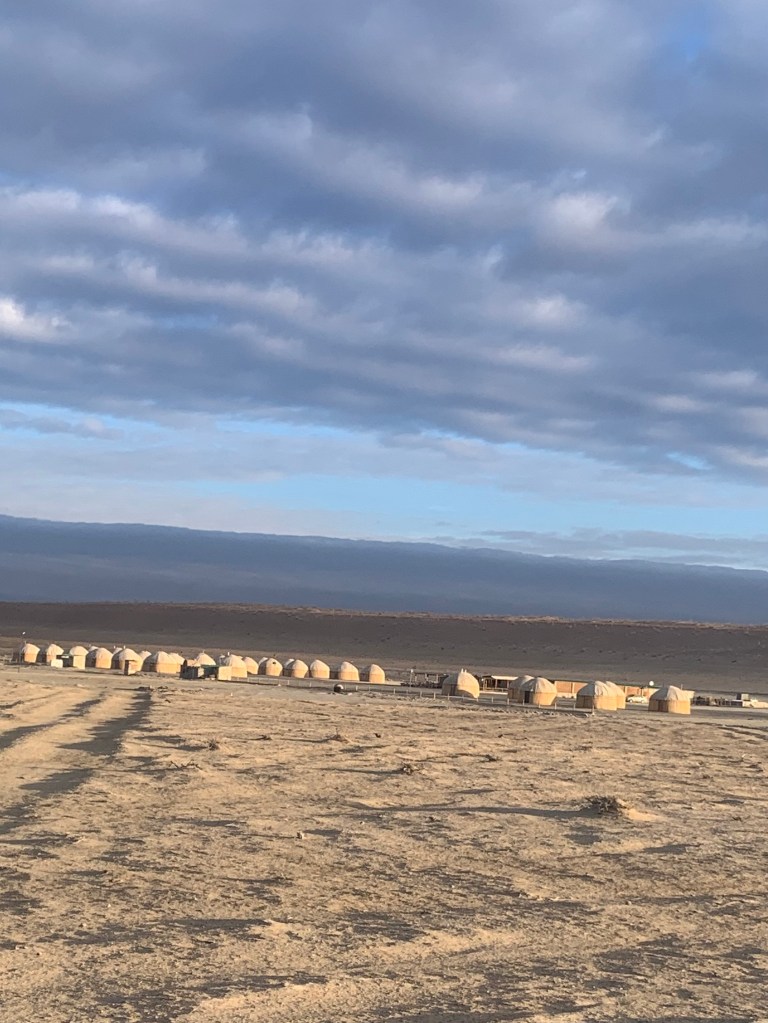
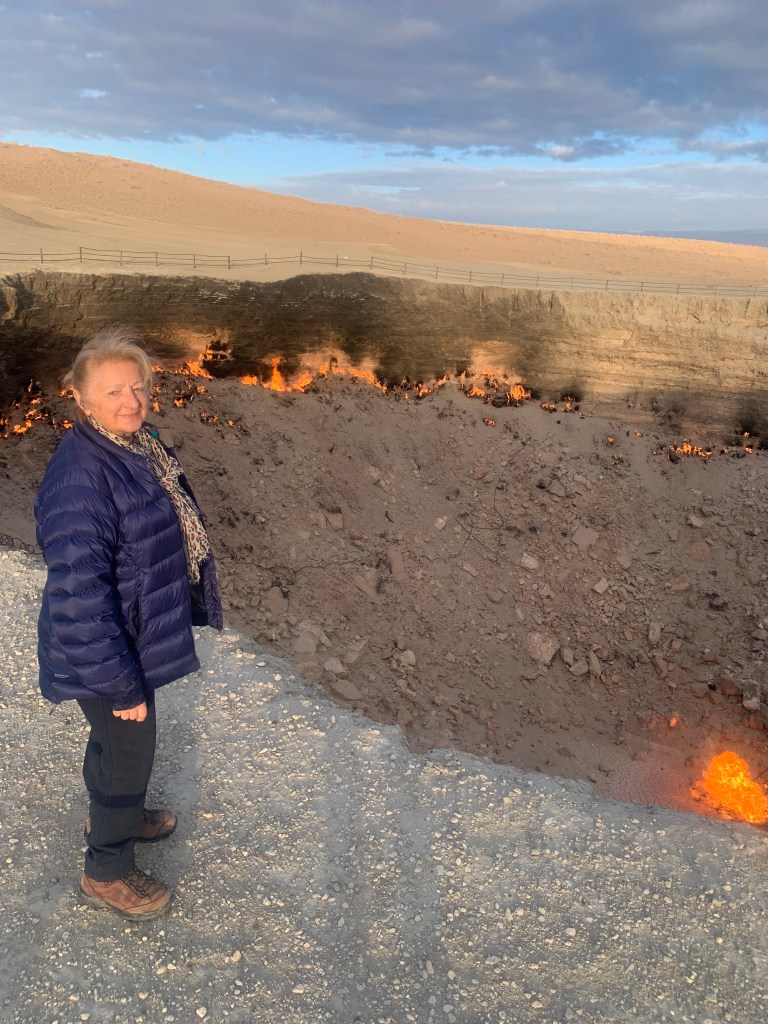
Then a long drive to Darwaza, in the middle of the Karakum desert, where The Gates of Hell gas crater has been burning since the 1970’s when the Soviet experts were prospecting for natural resources (Kara-kum means ‘black sand’, as there is a lot of shale underneath). I was told there had been a lot of heavy equipment in the area at the time and a spark may have caused an explosion that created the crater – there are metal bits and pipes visible at the bottom. The natural gas has been burning since. (It made me smile, thinking of the Azerbaijan’s “Fire Mountain”, which is but a smidgeon compared to the hundreds of clean, smokeless flames around the giant crater.
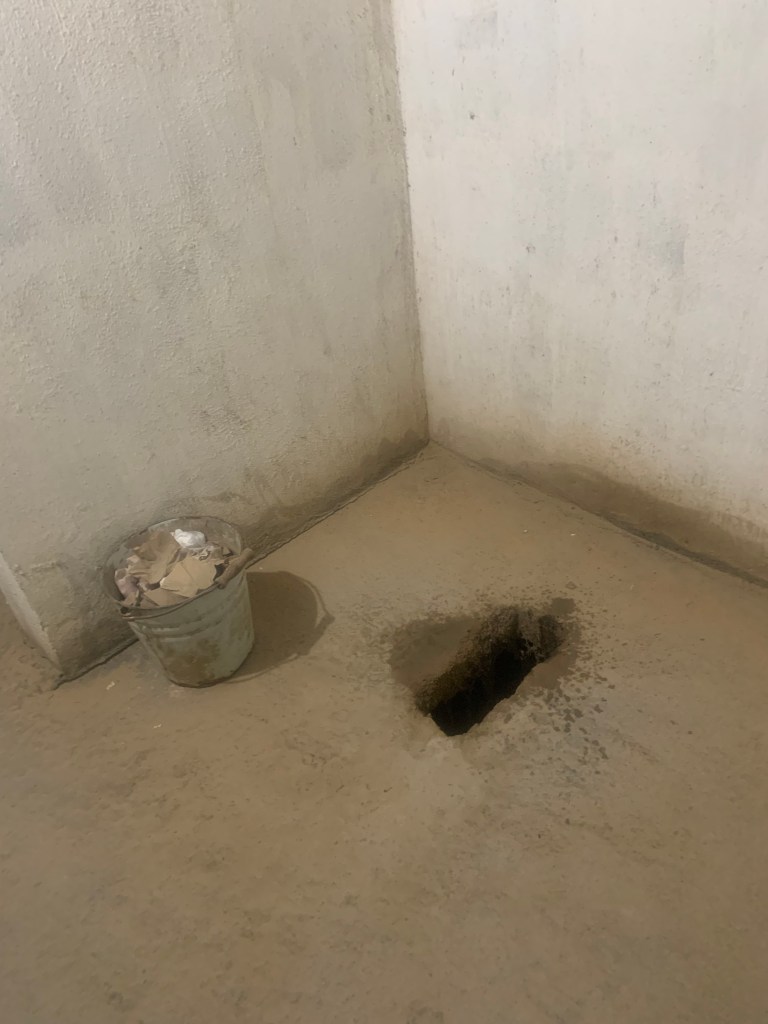
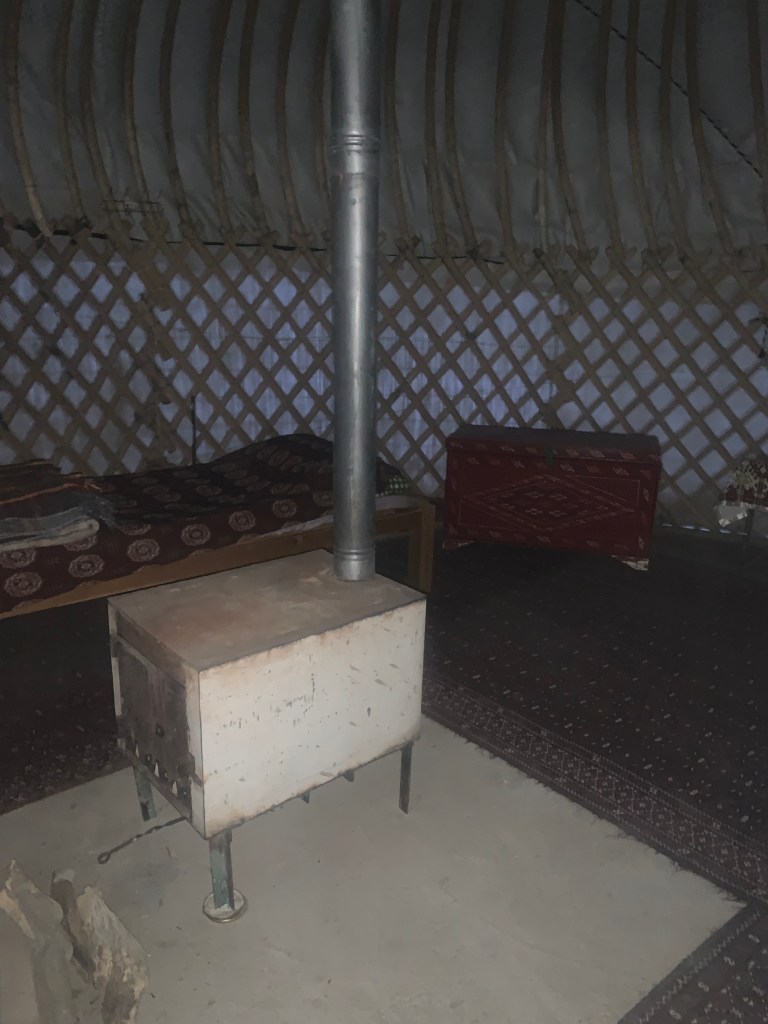
The yurt villageThe looThe Turkmenistan massage roadMy yurt stove
Owadan travel built and owns the yurts here and this is where I slept. This being February, I was, yet again, the only visitor. But I was well looked after, and there was a fire in the little stove in the yurt. (The loo, though, could not be put closer – at 50m, it is a trek.)
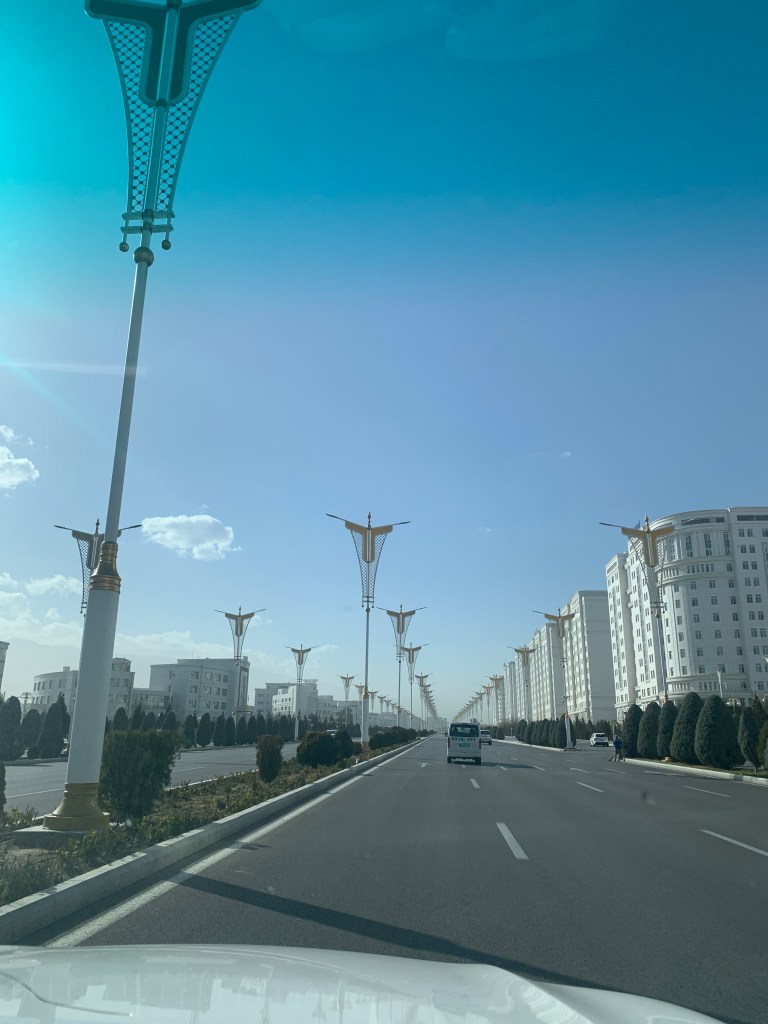
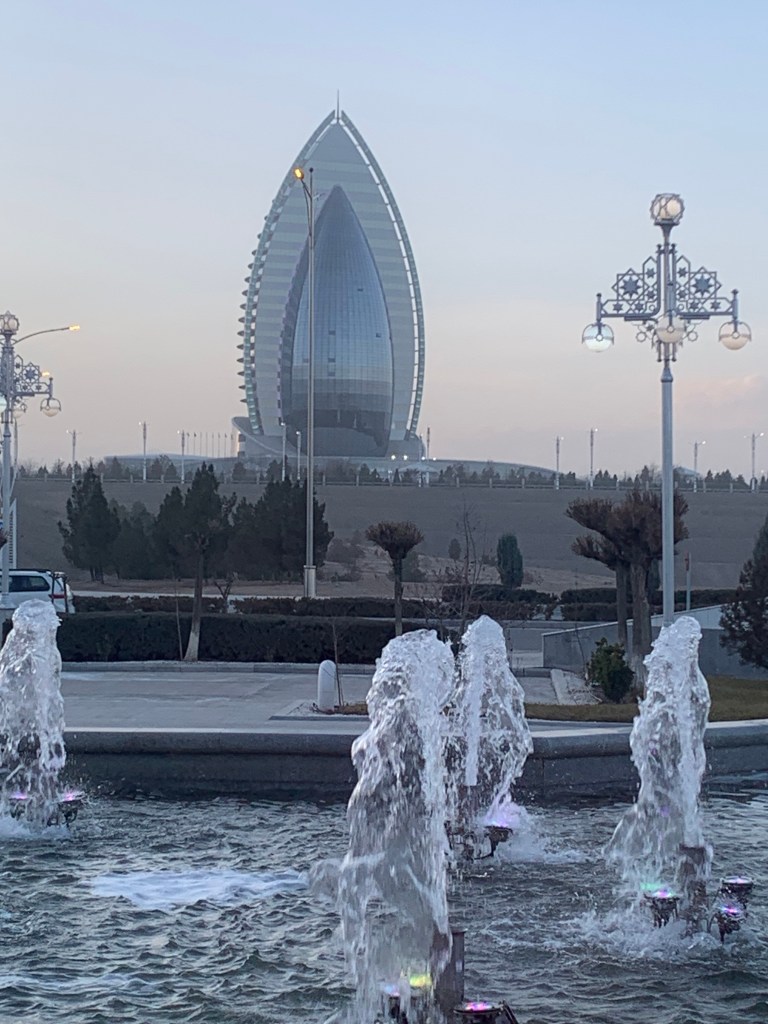
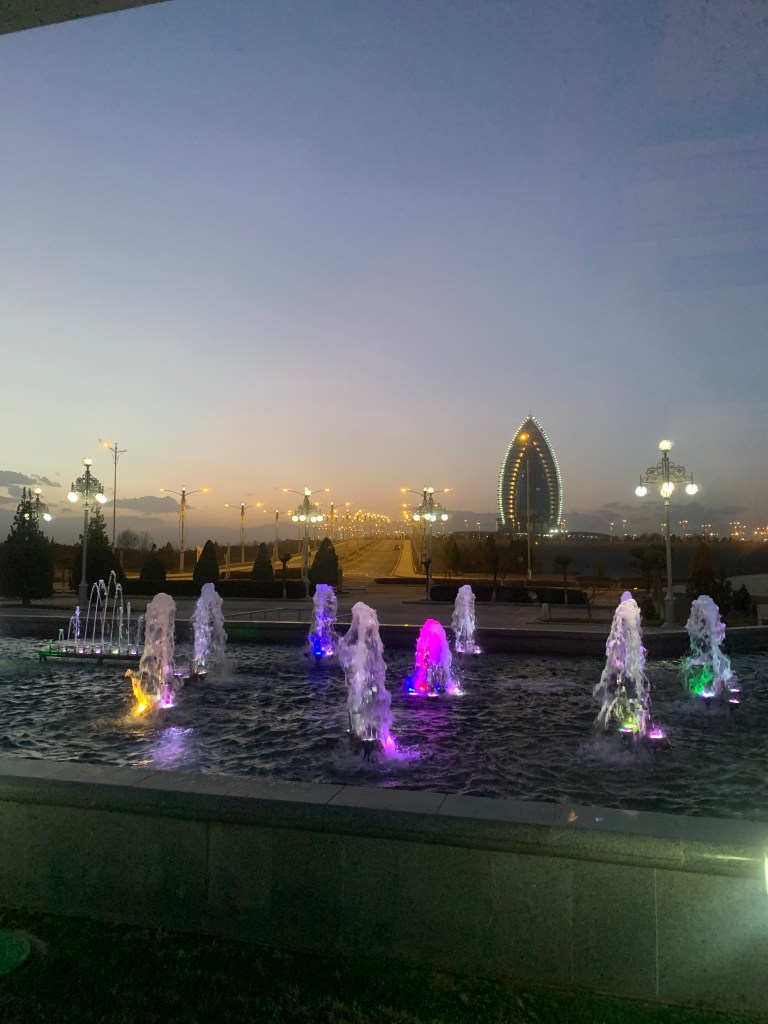
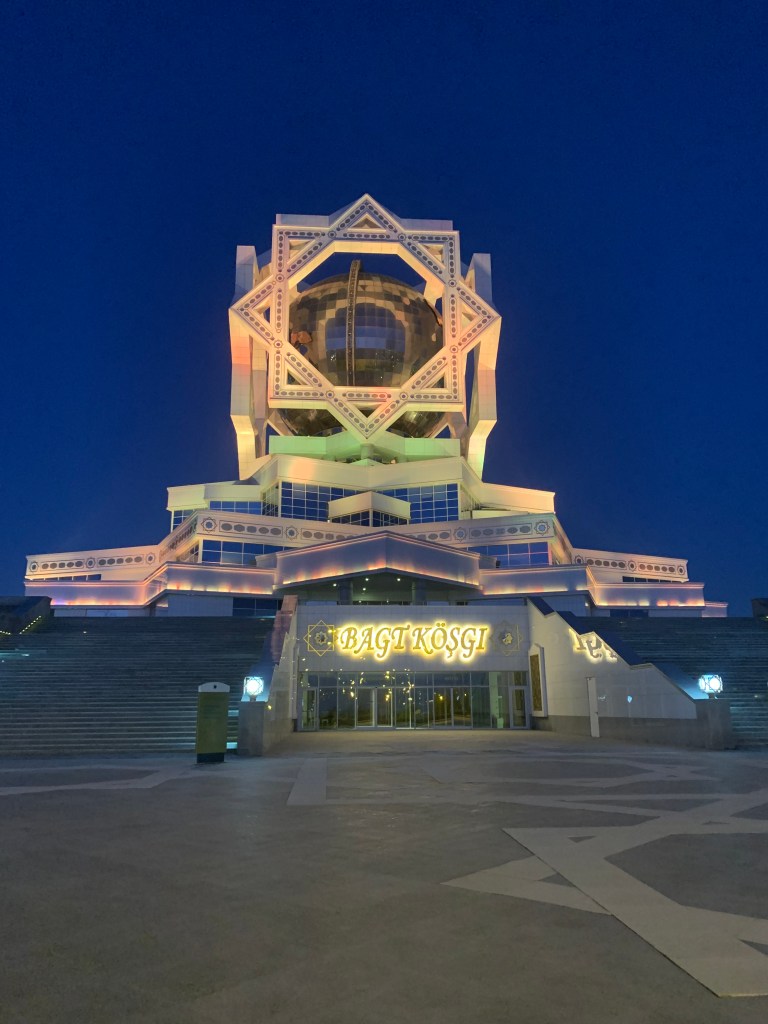
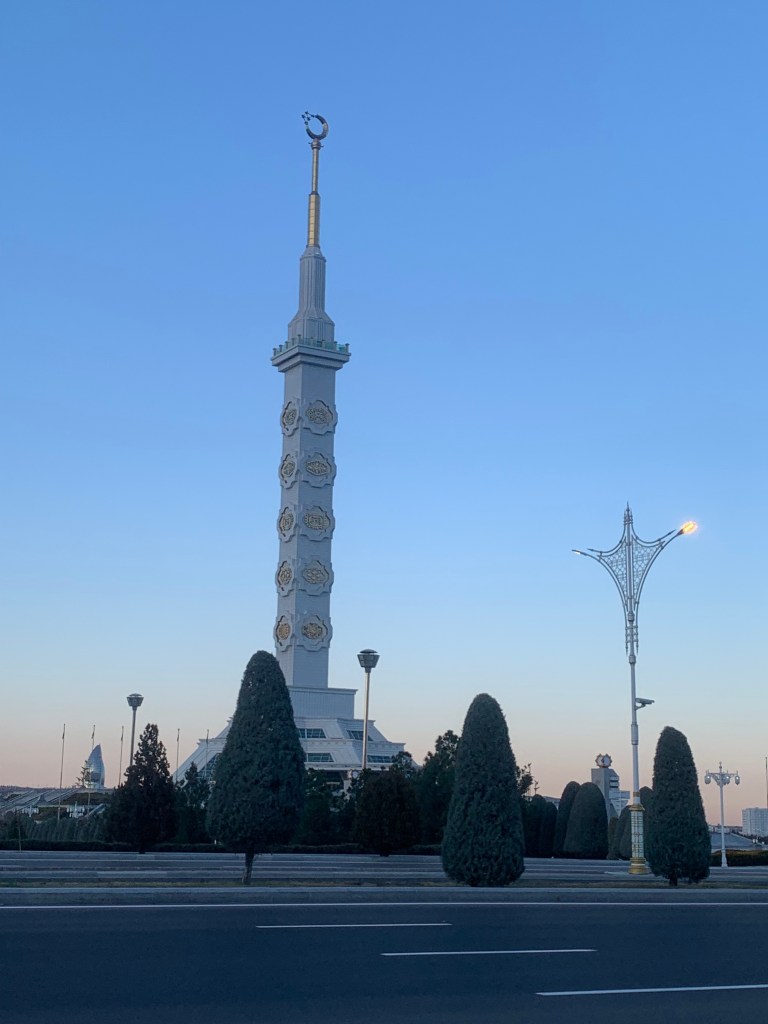
Ashgabat is officially “the whitest city in the world”. The buildings cannot be painted anything but white; the only cars allowed inside the city limits must be white, silver or gold; the street lights (and there are, for once, plenty) are all on white or silver posts. The cars must be clean – else they will get stopped by the traffic police and fined. This has occasioned a very brisk business in car washes in the environs of the city (The Toyota was washed 3 times in the 6 days I was there.) Out of the 5 provinces, cars registered in 2 (Dashoguz and Mary) cannot enter Ashgabat, whatever their colour and state of cleanliness – they must be left on the outskirts. The city roads are in perfect condition, wide and spotlessly clean. Very few people outside, except for the street cleaners (mainly women with brooms). No traffic jams. There is a sterile and sterilised feel to the town, as after an apocalypse. However, when the night falls, the psychedelic multicoloured lights play on every building, including the high rise apartment blocks.
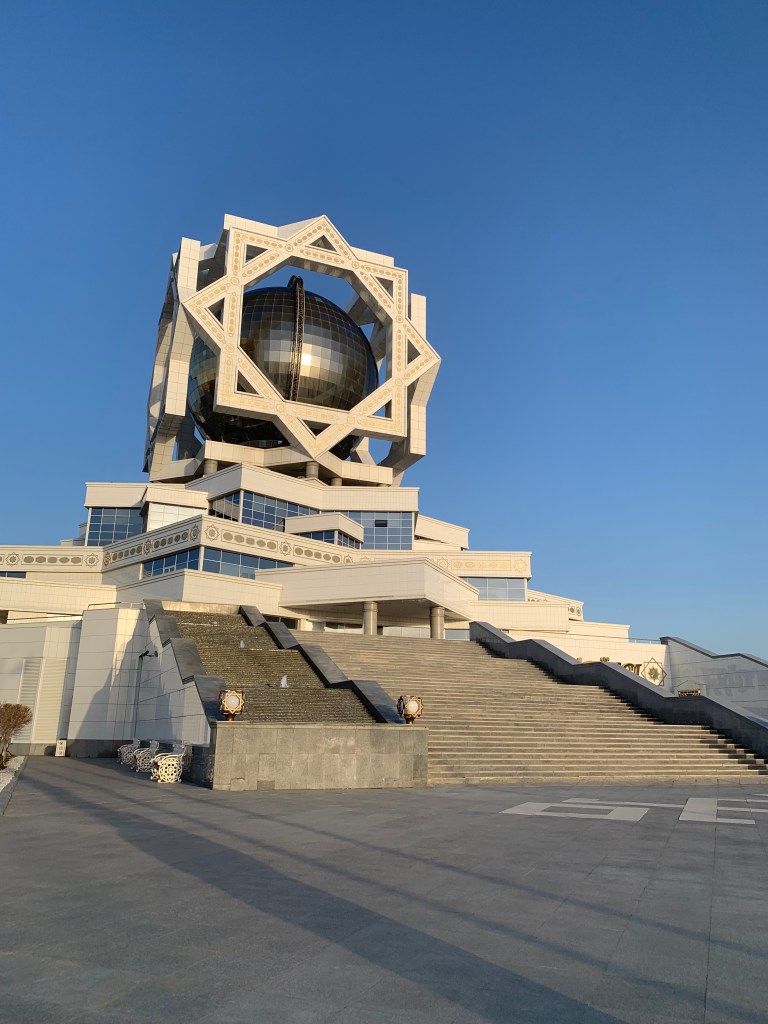
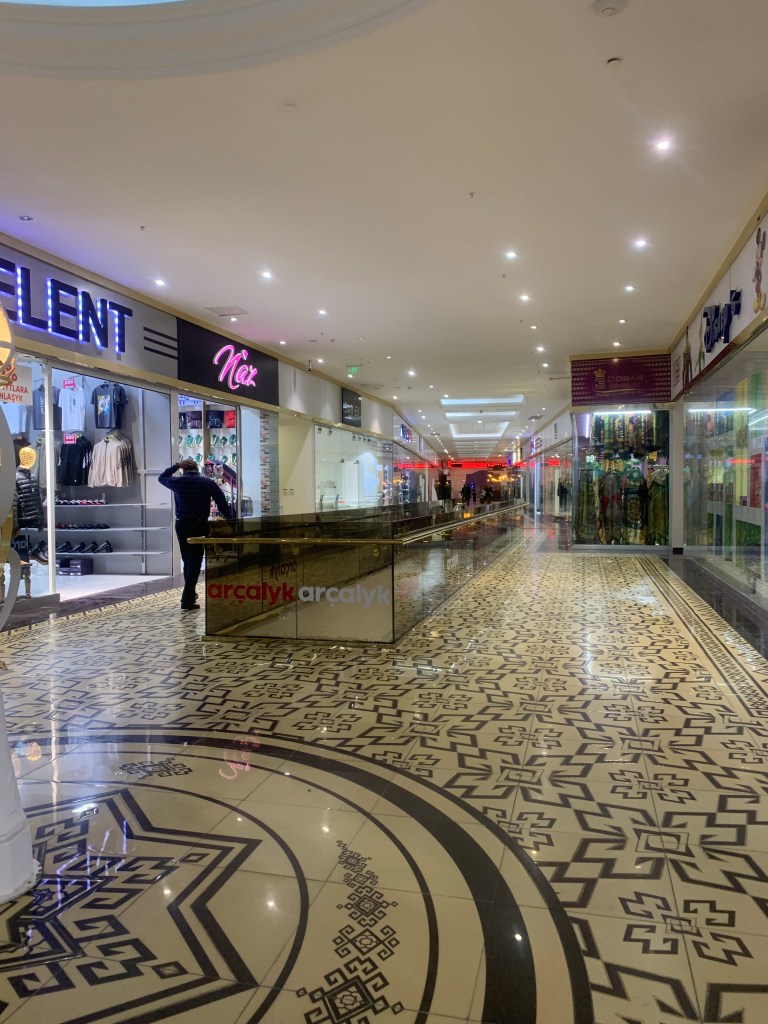
Arriving in AshgabadThe Wedding Palace – the hotel I stayed inMy view from the room towards another hotel – only parks in betweenThe evening falls and lights start playingMy hotel at night – colours changeThe shopping mall
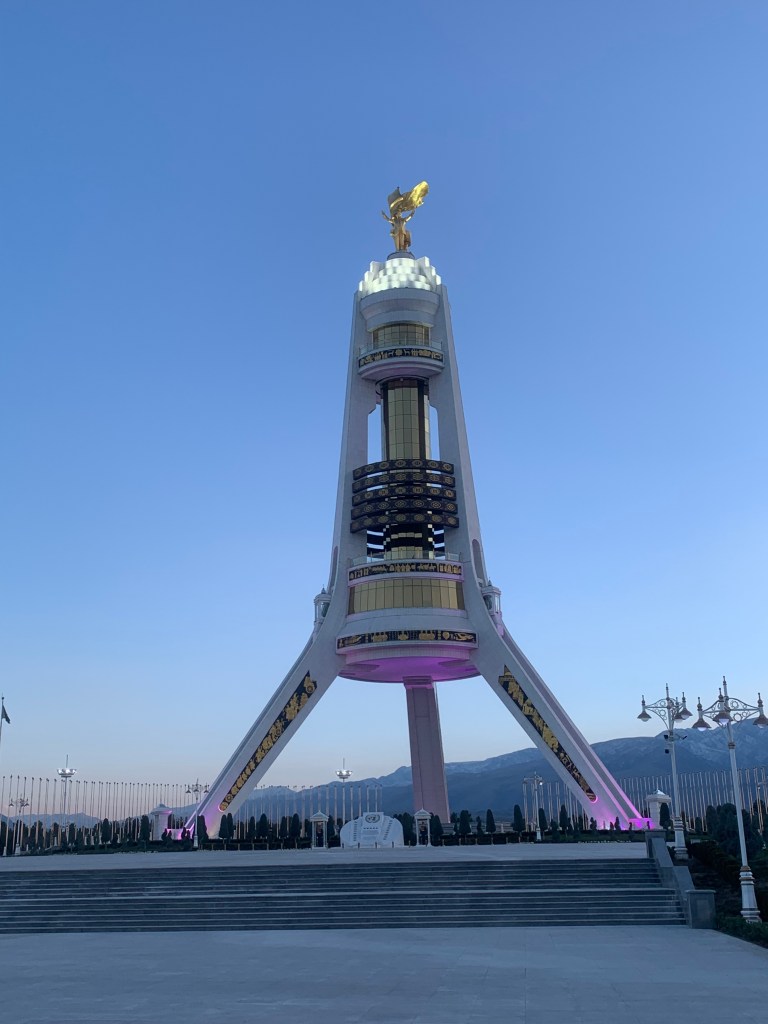
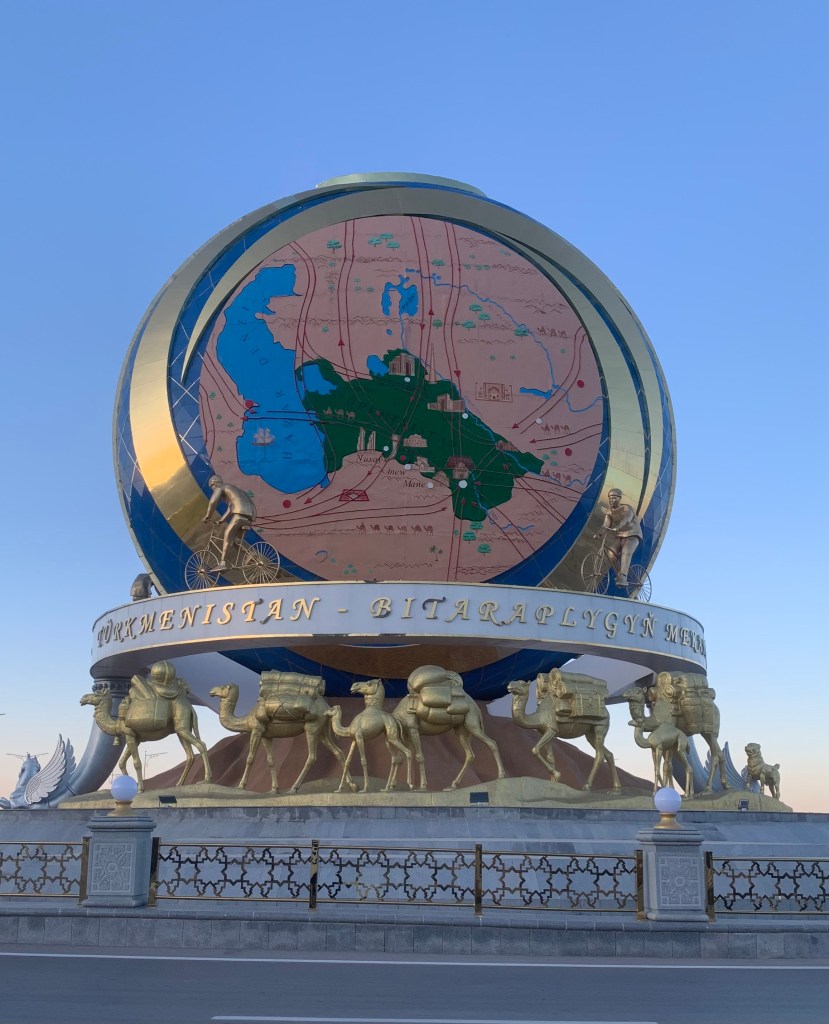
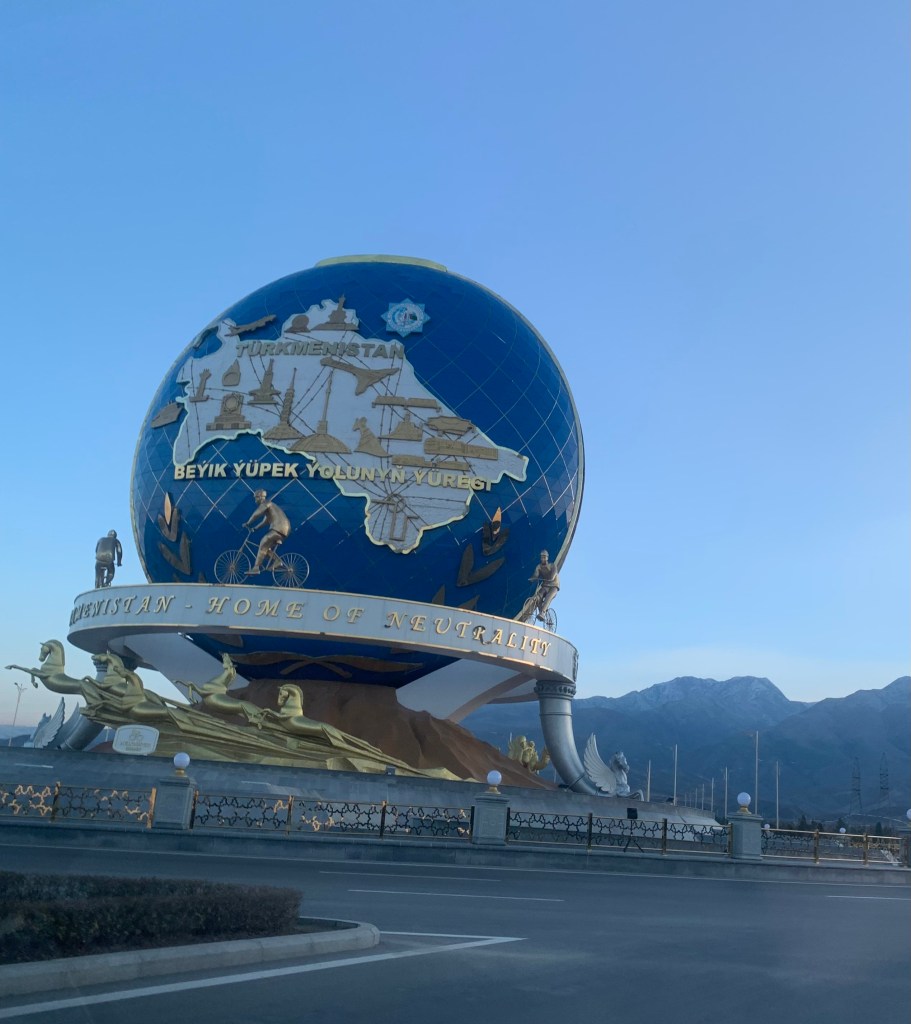
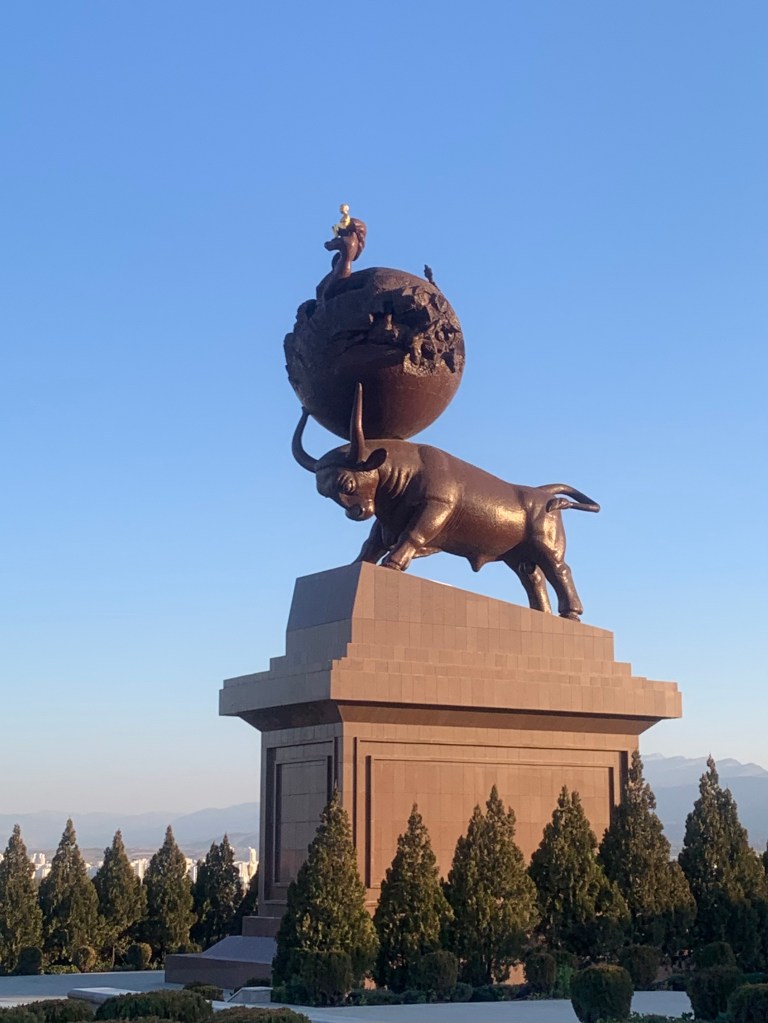
The monuments are highly visible, grand and quite literal: the monument to Independence is 91 metres tall as the event happened in 1991; the monument to Neutrality is 95 metres tall (1995). Every roundabout has a monument as a centrepiece.
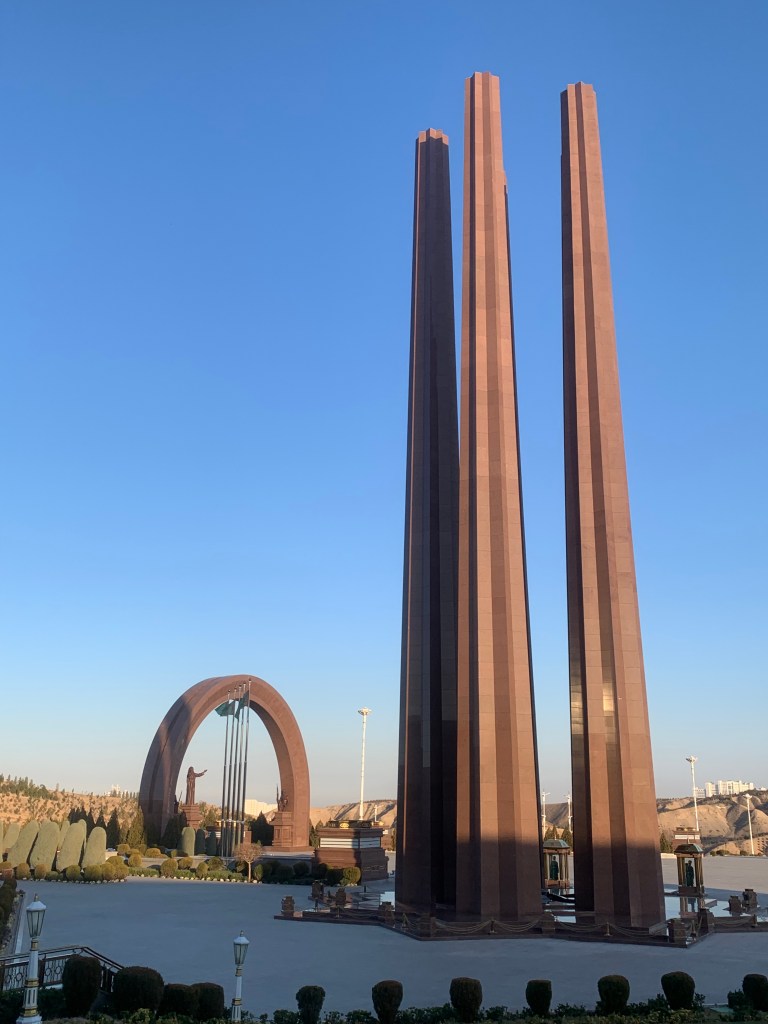
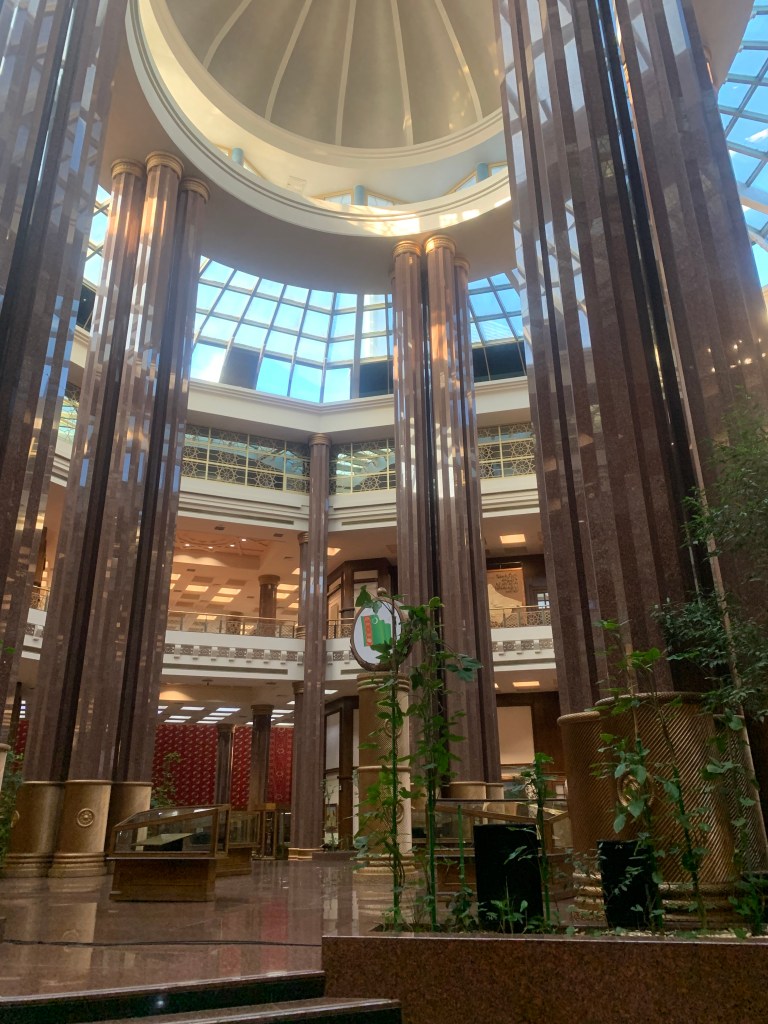
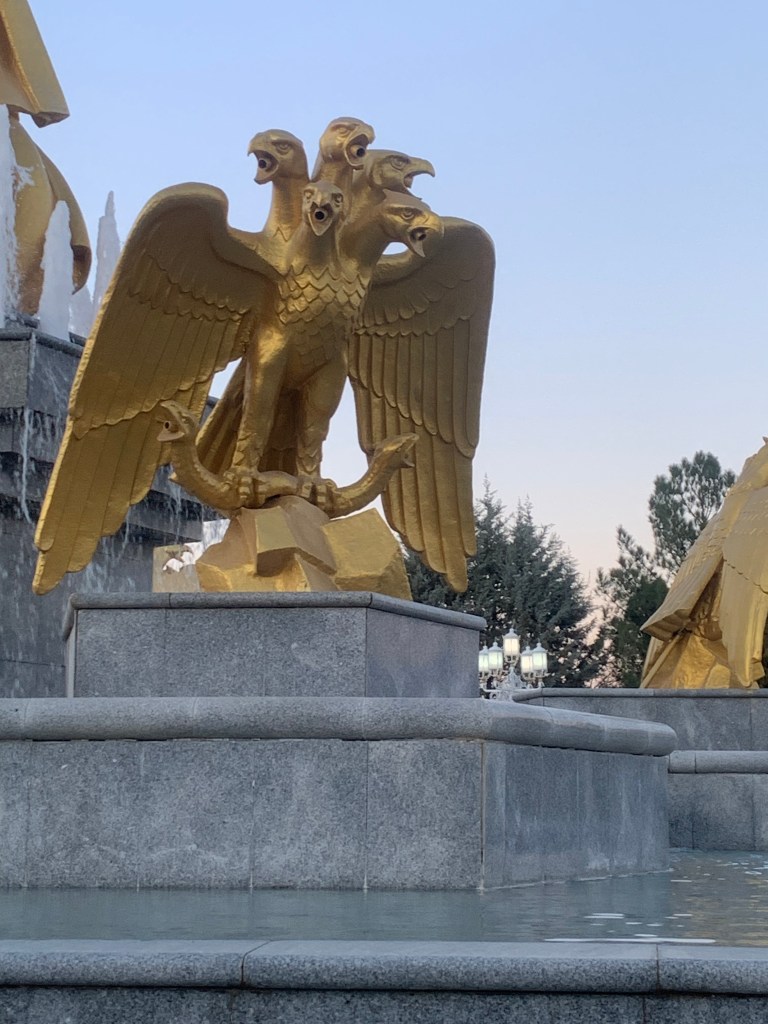
There are some odd things – such as the largest (and only) Ferris wheel inside a building (I did ask, why?). The national flag pole may not be the tallest but is the only one in the world with a jet engine installed to ensure steady fluttering. The five tribes that make up Turkmenistan are represented on the flag with the ancient symbols often seen in their carpets; the National Museum of Turkmenistan incorporates the five pillars inside its architecture, the Memorial complex has five pillars to commemorate the loss of life in the war, there is a 5-headed eagle…
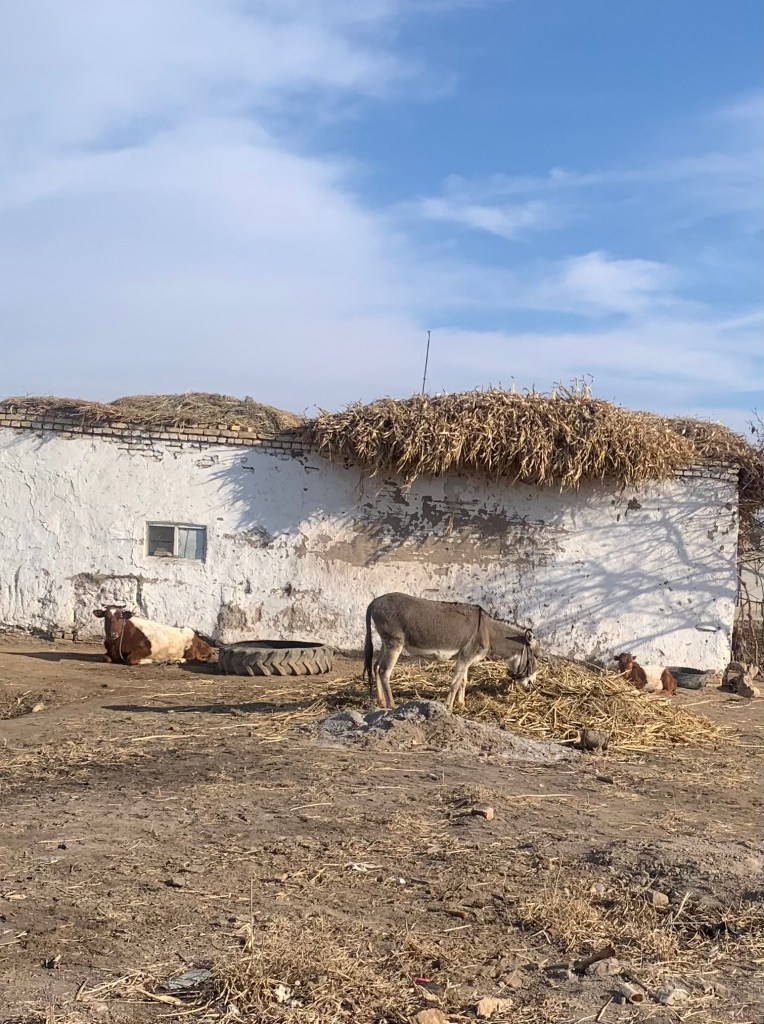
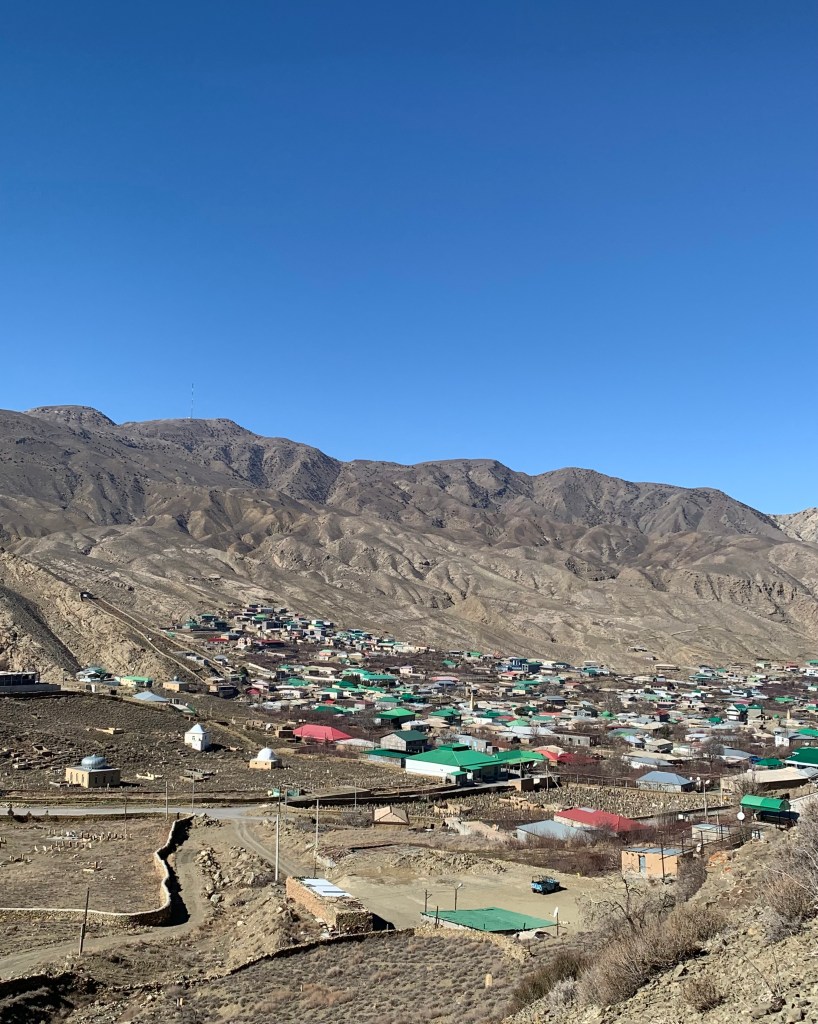
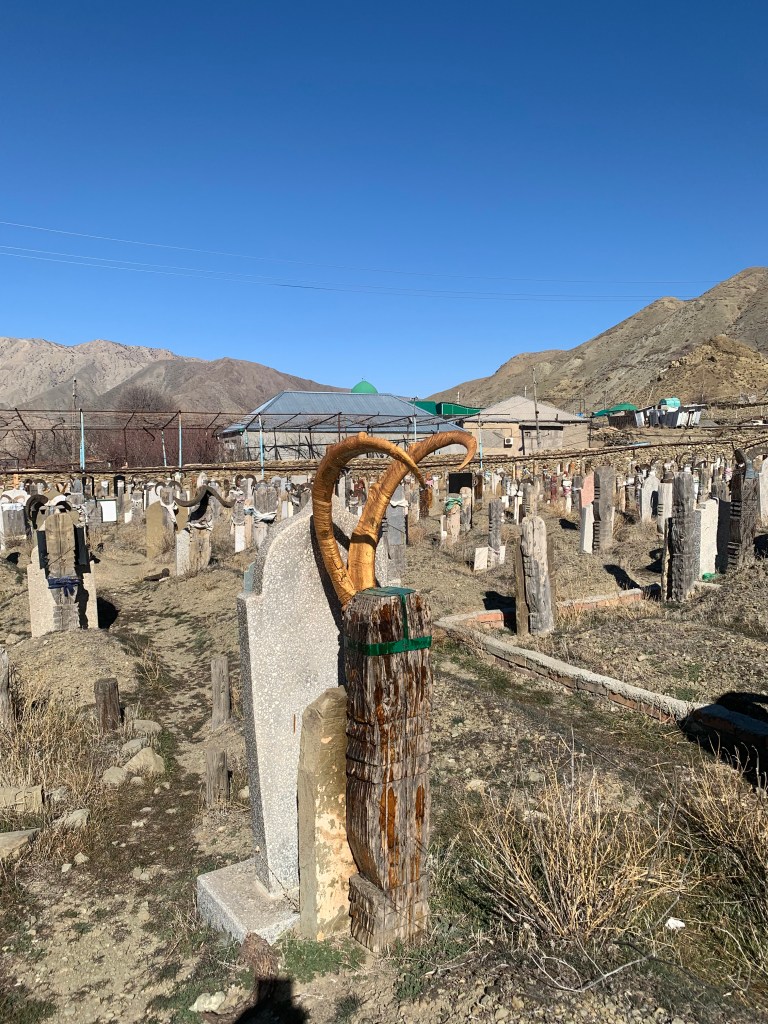
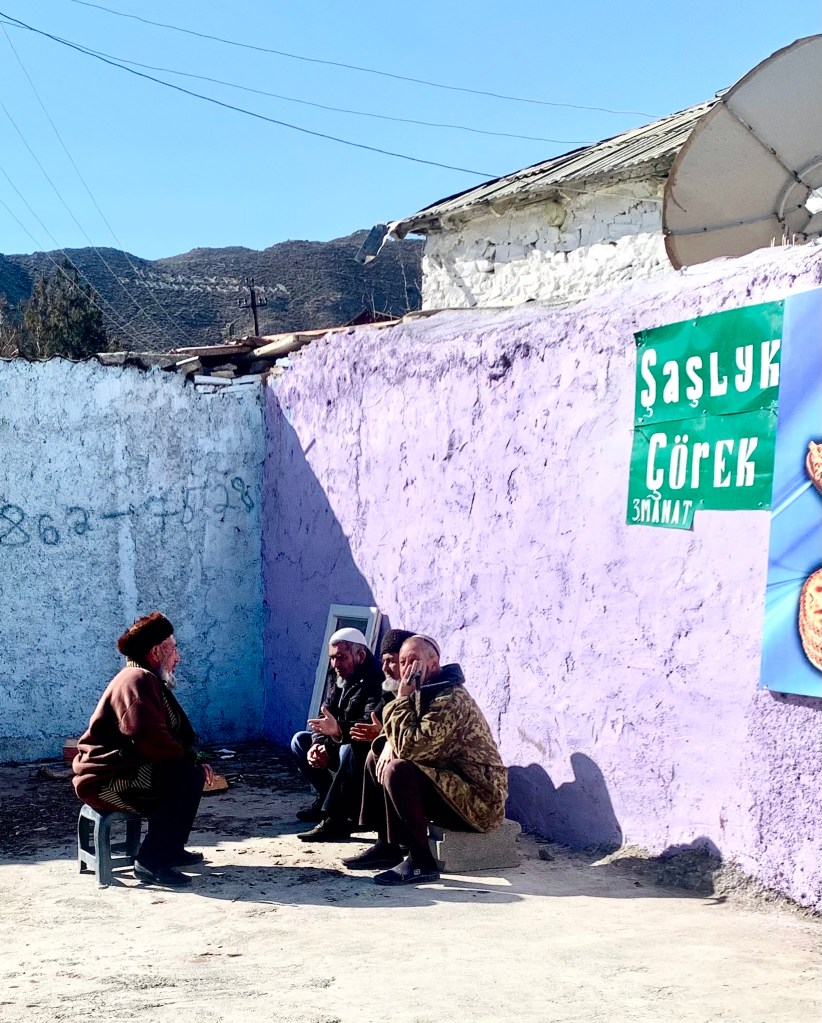
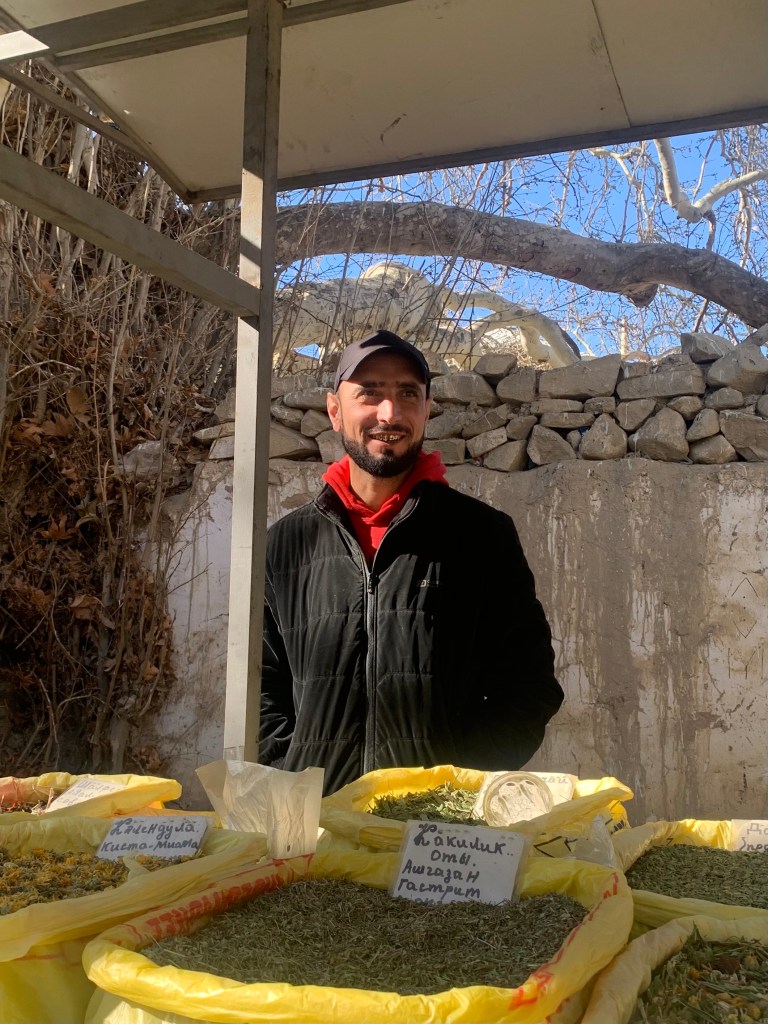
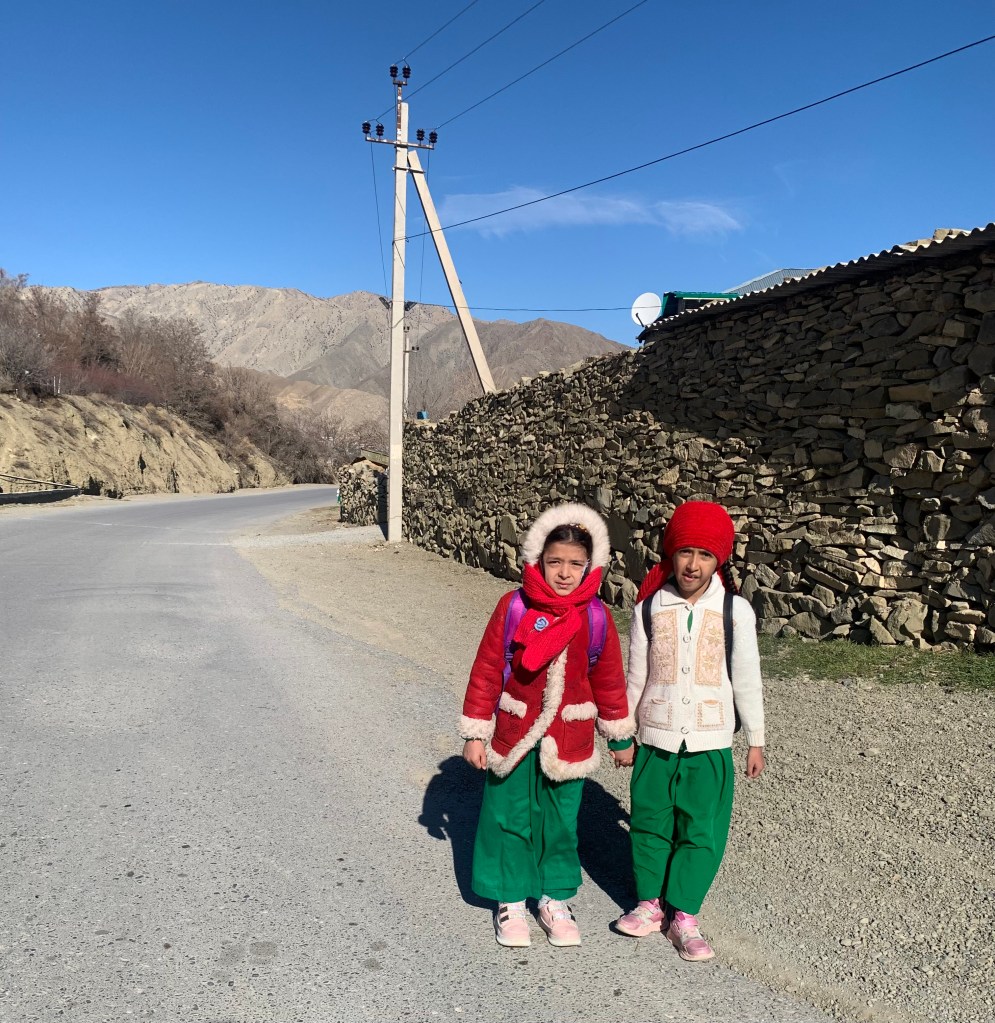
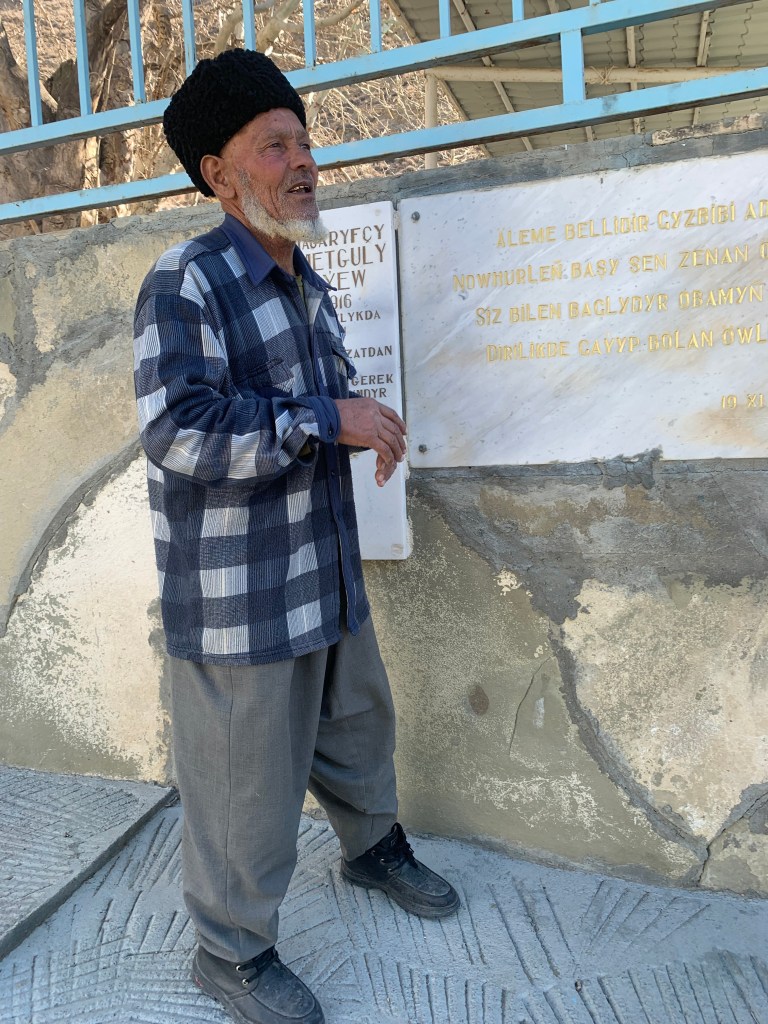
The visit to Nokhur village (where people put ram’s horns on the graves – one story is that it’s to ward off evil spirits, the other that it is just a decoration) finally gave me an opportunity to see how ordinary people live.
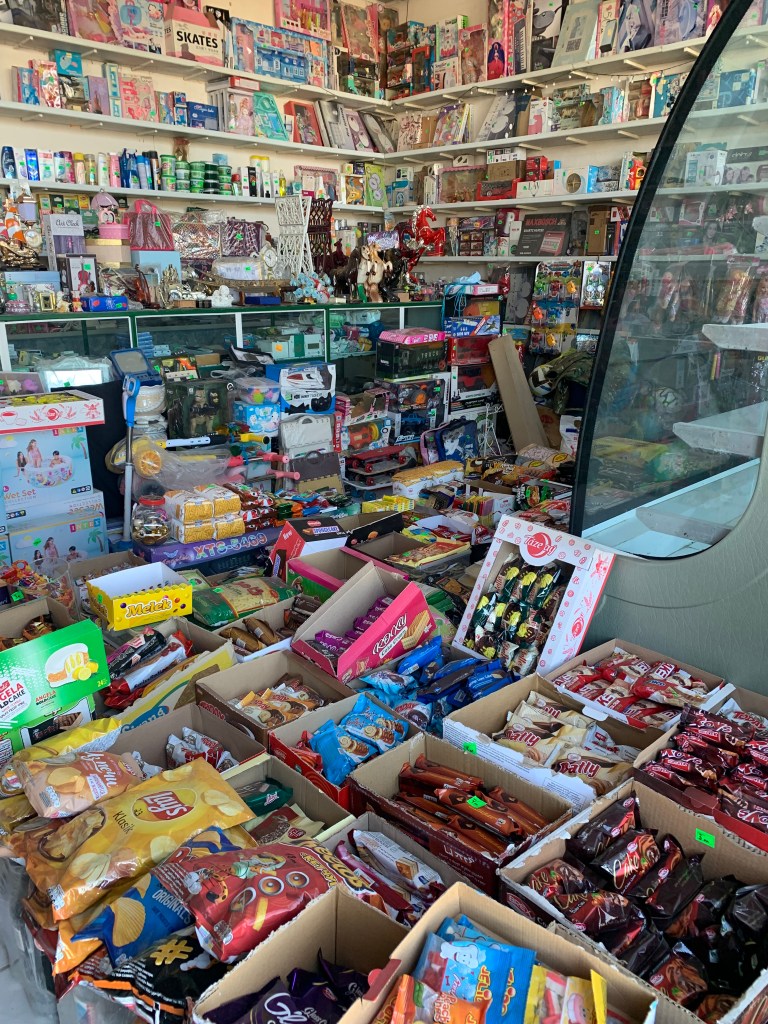
Nokhur from aboveHorns on graves in NokhurSchool uniform Good spot for a chatThis lovely lady with a golden smile gave me some home made breadBought some tea by the old china tree
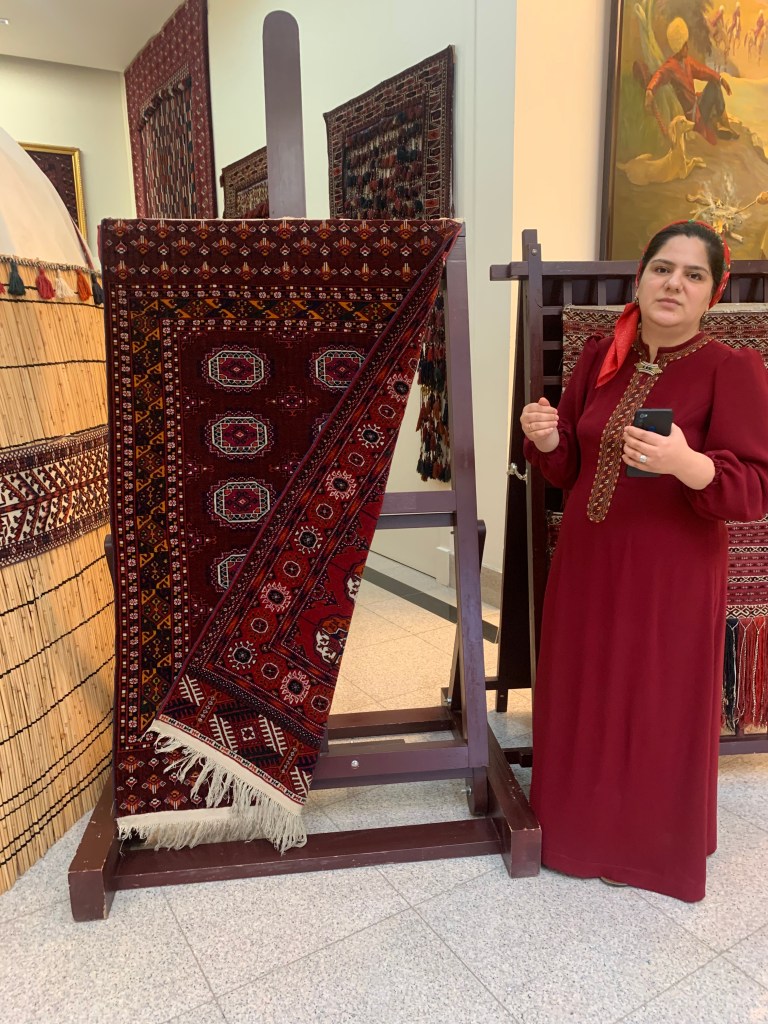
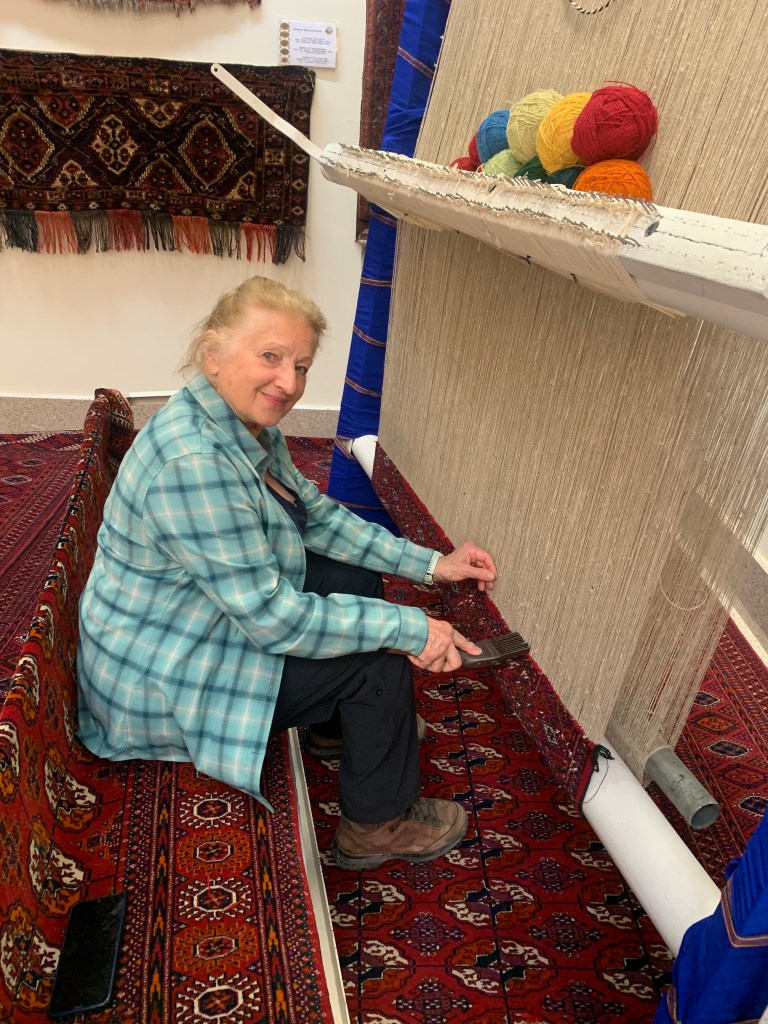
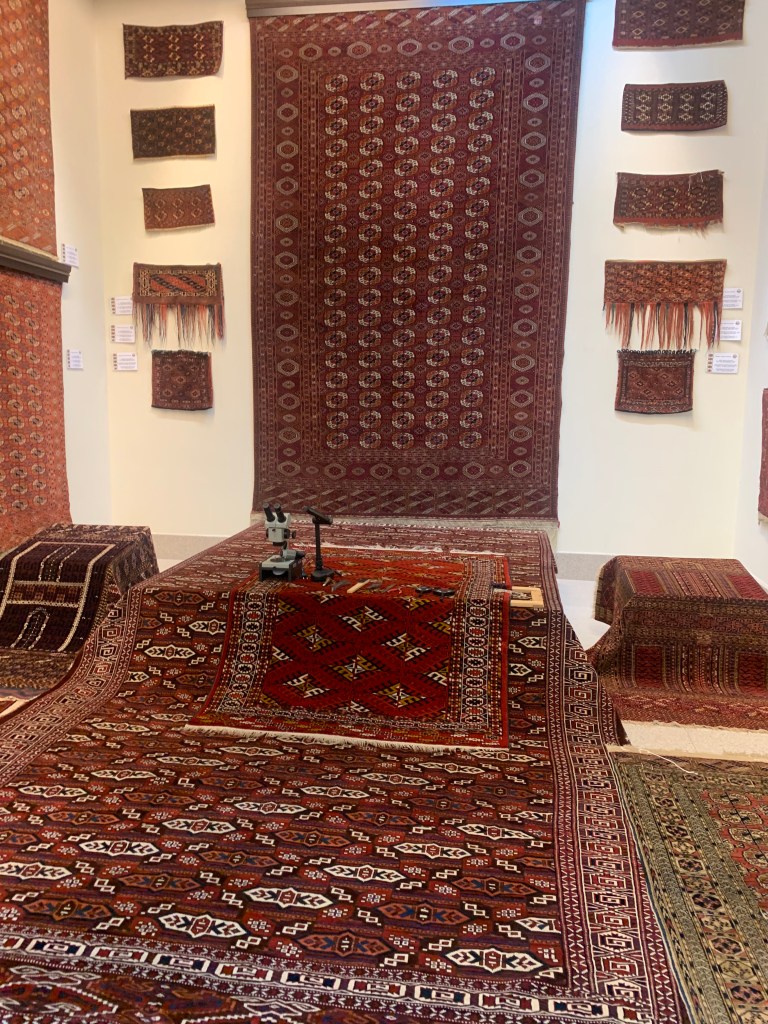
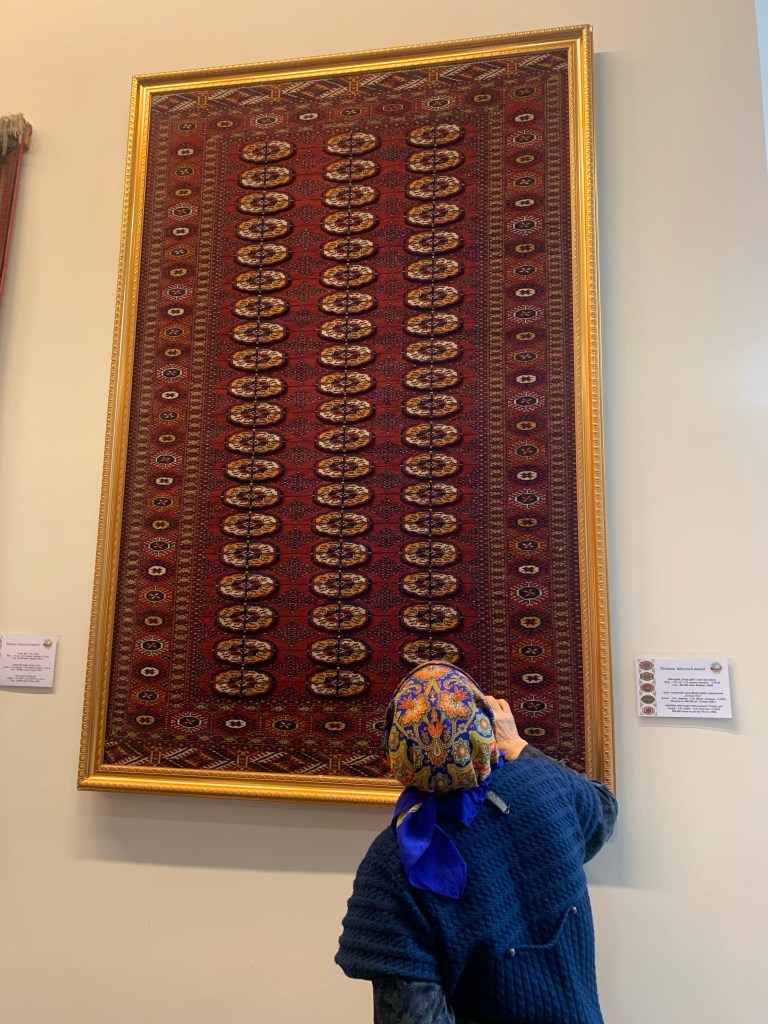
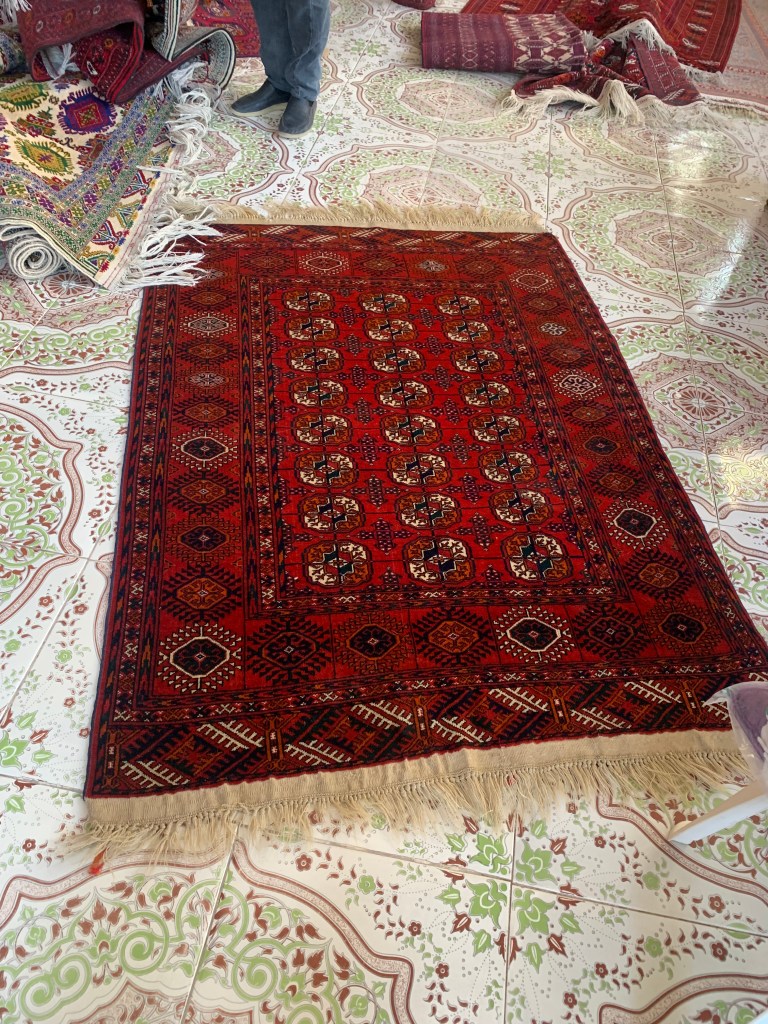
I enjoyed the visit to the Carpet Museum. We all know of the “Bokhara” carpets as the best quality hand-knotted ones. But they were only SOLD in Bokhara and have always been made by the Turkmen people. I did drool over a couple of them. Later I really wanted to buy one (in the shop in Mary) – but I would not have been given an export license as it was over 60 years old.
A 3-D carpet – the light ovals are raisedA 60-year old beauty I wanted
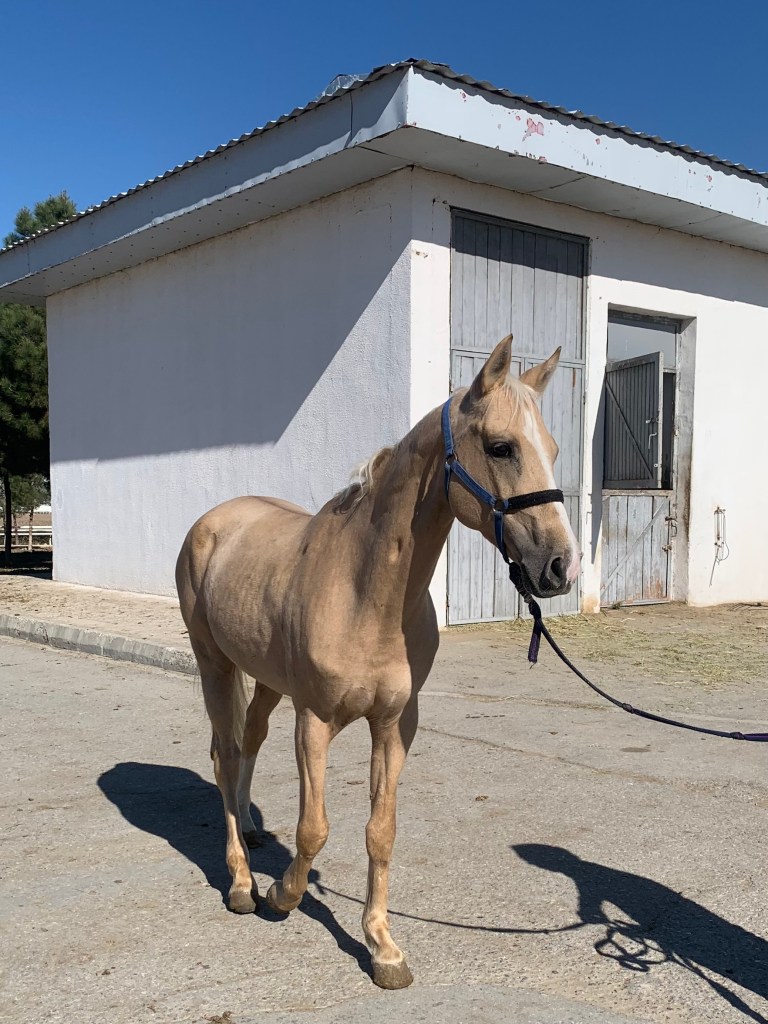
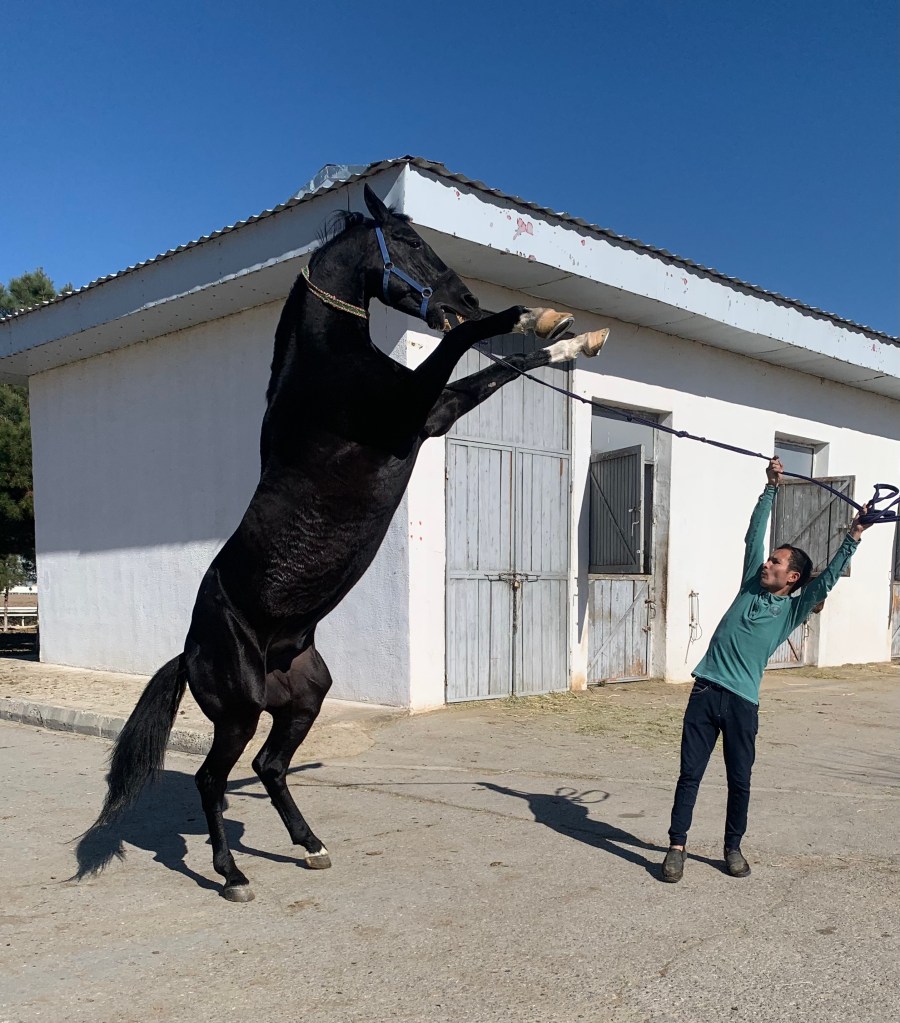
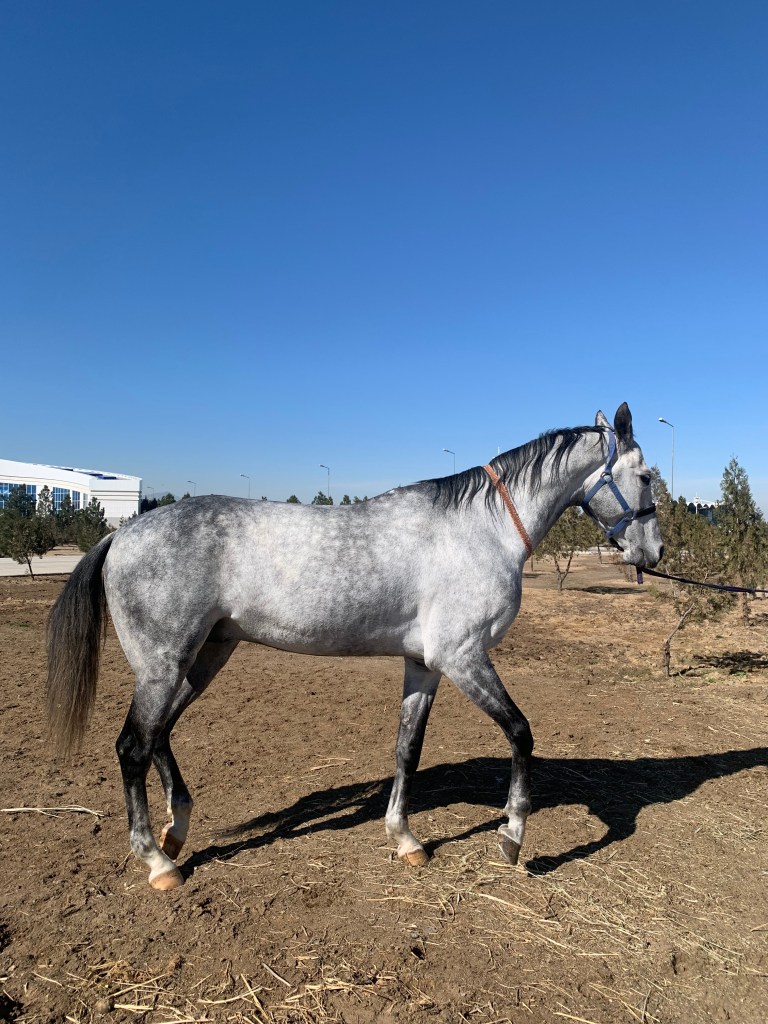
Turkmen are well known for their horsemanship and I was looking forward to seeing the “golden horses”. The Stables near the race course is a home to 600 horses, the Akhal-Teke among them. (I was told that the late Queen was gifted an Akhal-Teke horse by Turkmenistan and the grooms were convinced that the horse had been painted gold and tried to wash it off.) I could have had a ride ($10). Were I a better horsewoman, I might have had a go. They all looked well looked after, if a little frisky (the black stallion is known for being headstrong).
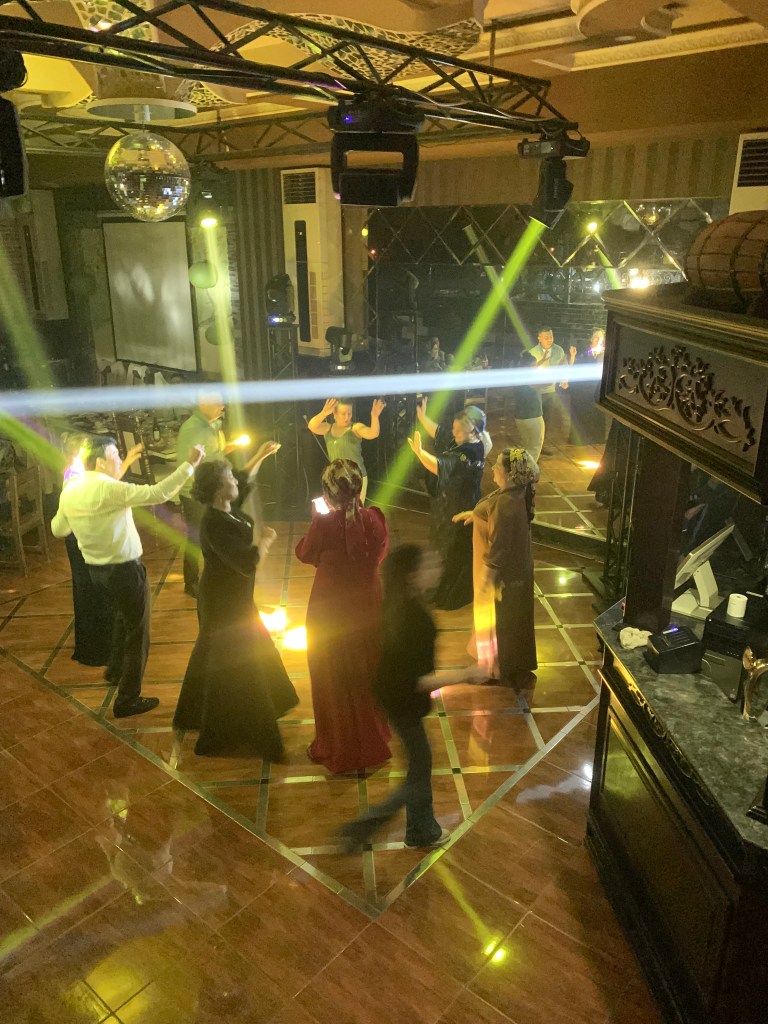
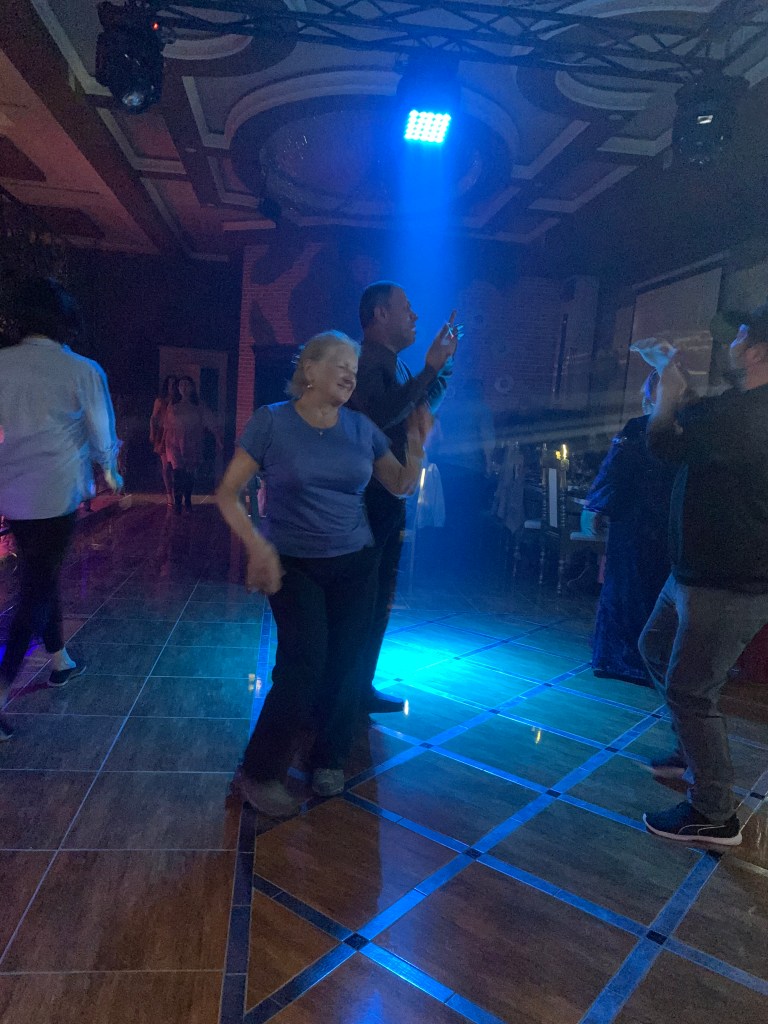
The original programme had me staying in Ashgabat for 3 days, with a couple of trips out. As we more than covered Ashgabat in 2 days, we headed to Mary – the old Merw of the Silk Road (the new town is some 45 km southwest from the ancient city – the river Murgab changed course. Merw is 350 km away from Ashgabat on the road that could be better. There are a number of checkpoints where everyone must slow down; there are also random stops and car document checks along the road. Having the green license plates (a government vehicle) helps but is not a guarantee. (The foreign business partners/investors have yellow plates; the diplomats have blue; folk have white.) One is not allowed to take photos of the checkpoint or police in action. It was good to get to Mary a day early – poor Guwanch would otherwise have had to drive some 800km in one day on those awful roads. It also gave us a nice evening out – dinner and disco!
Approaching a police checkpoint
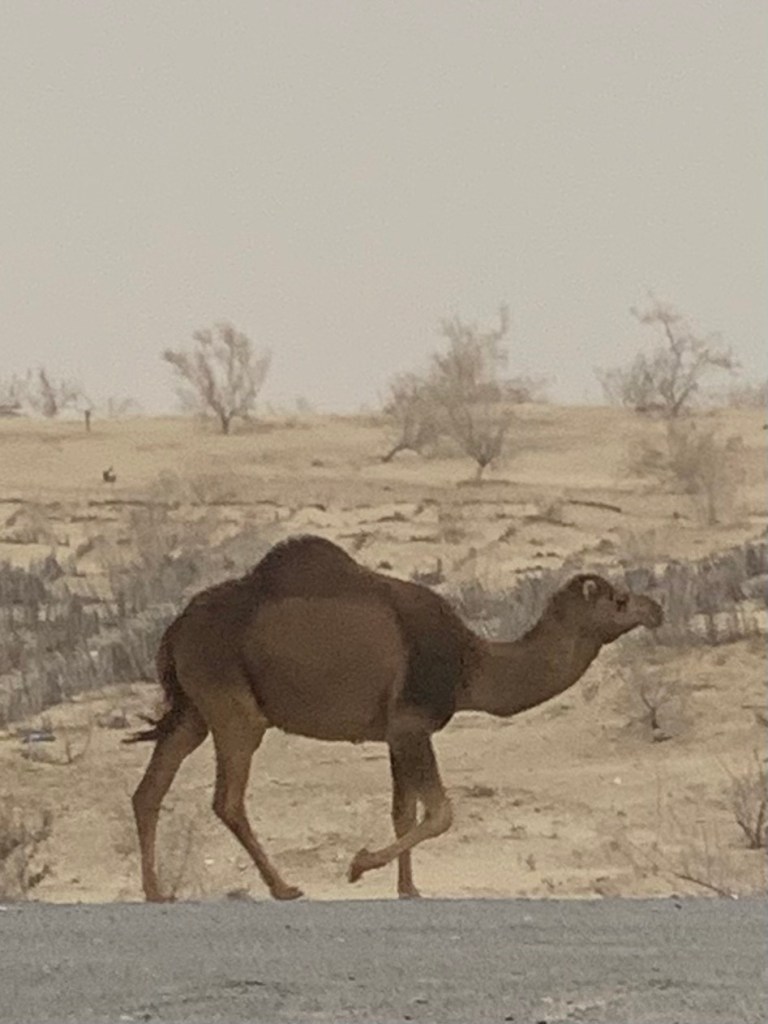
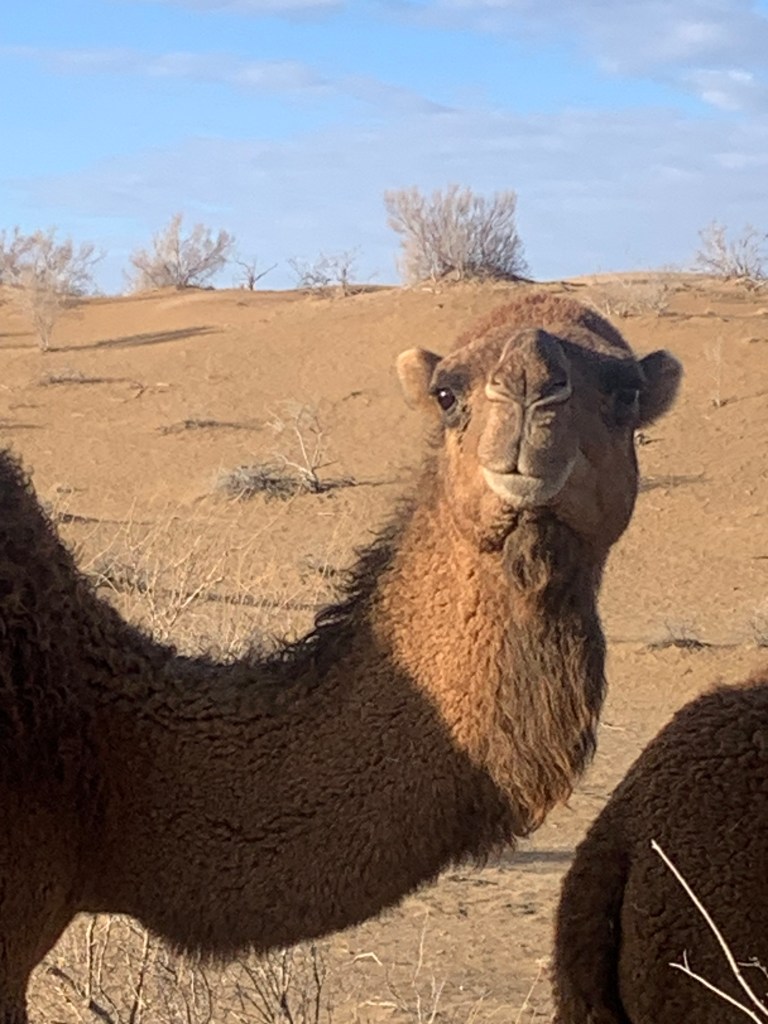
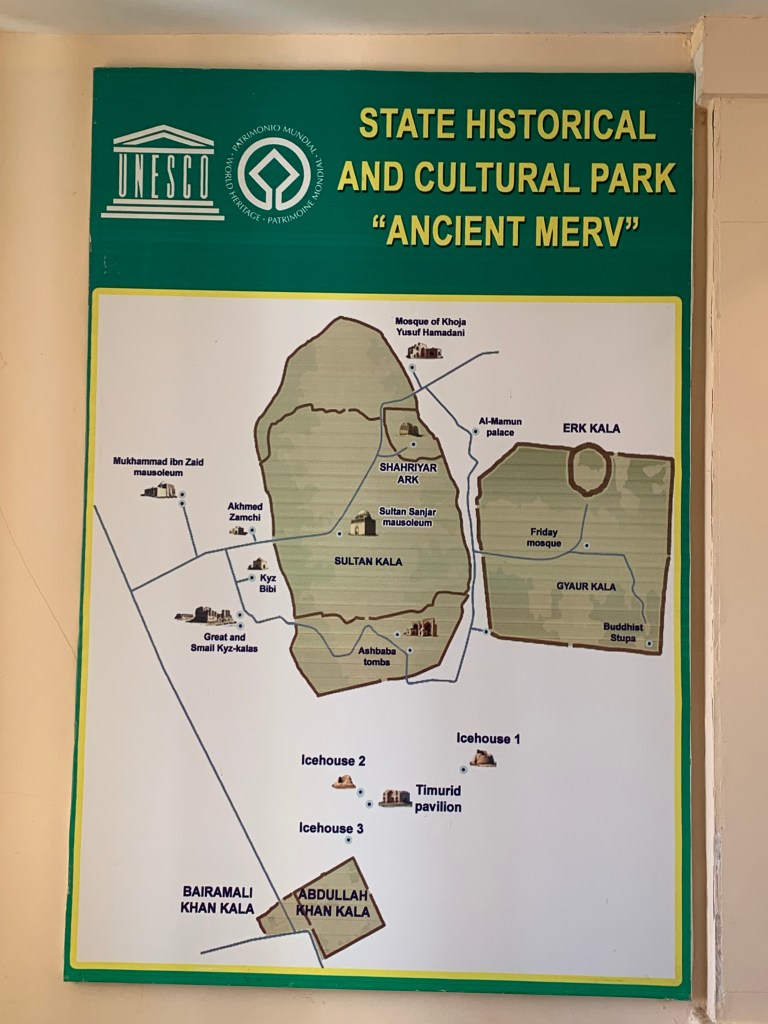
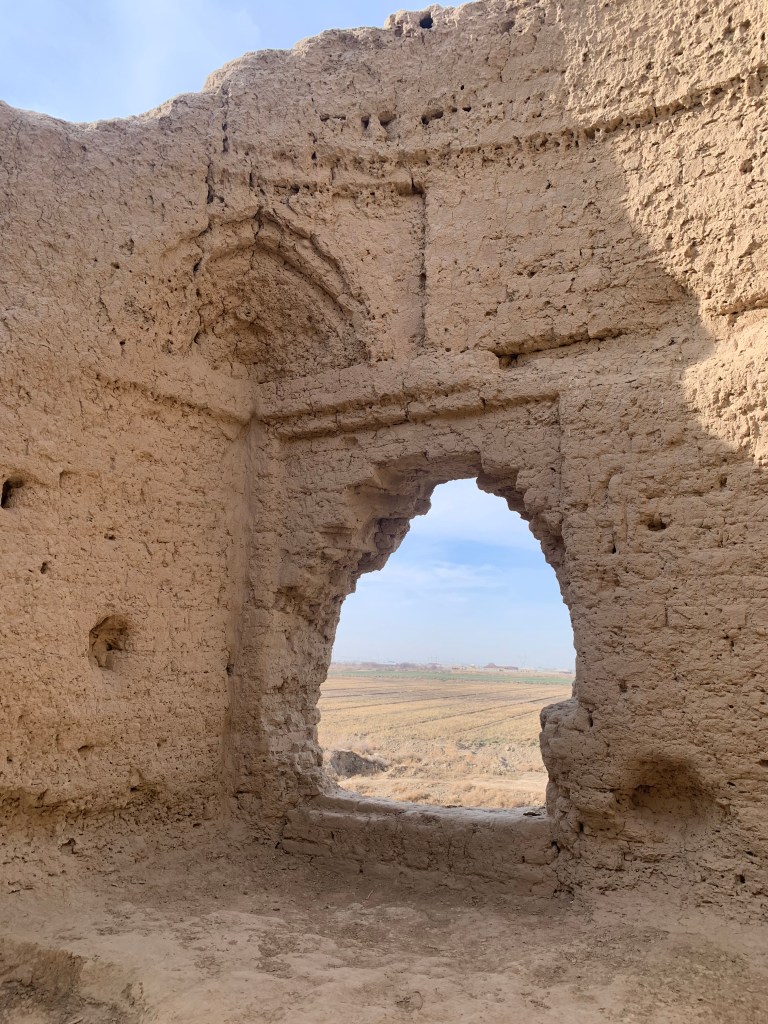
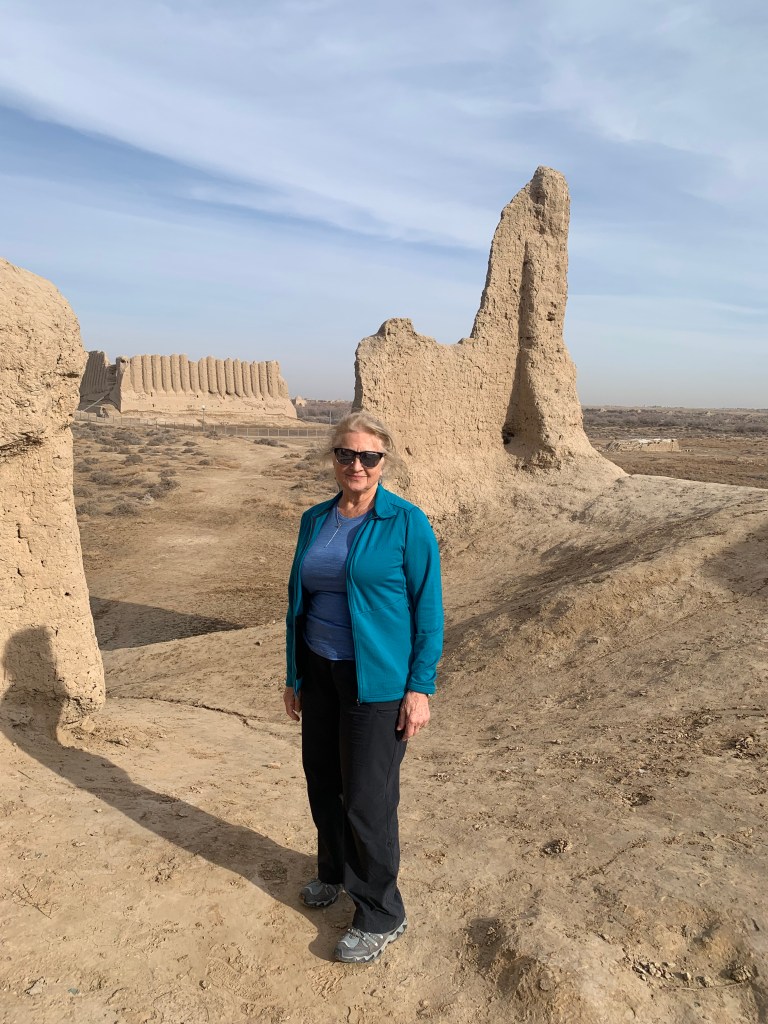
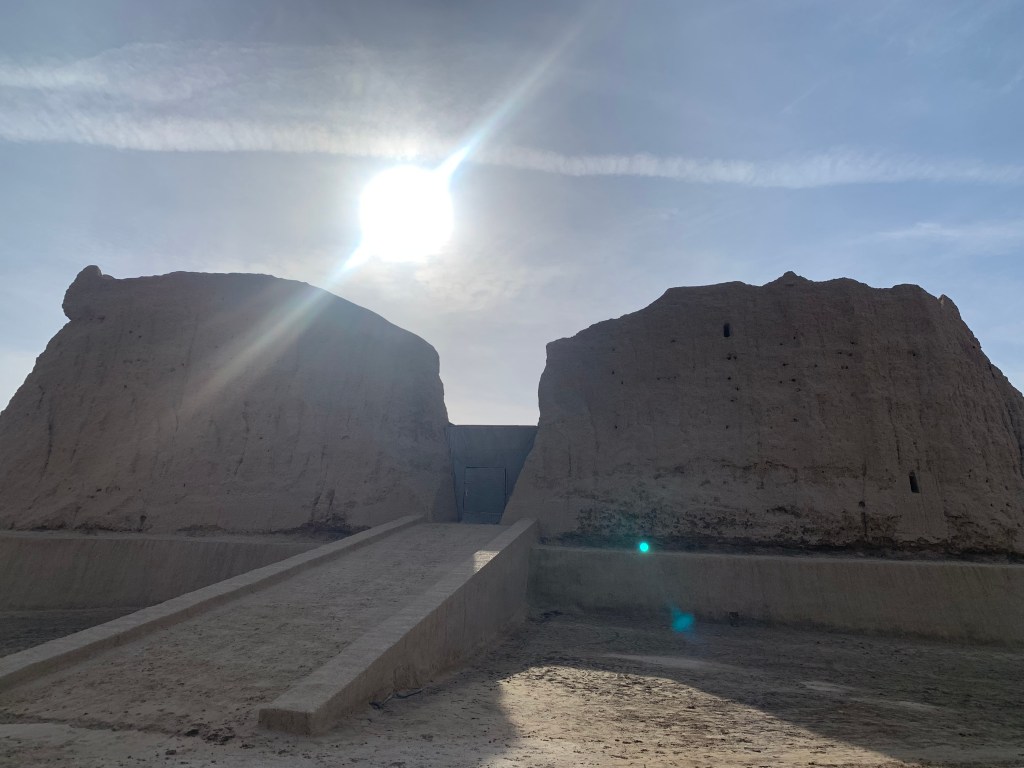
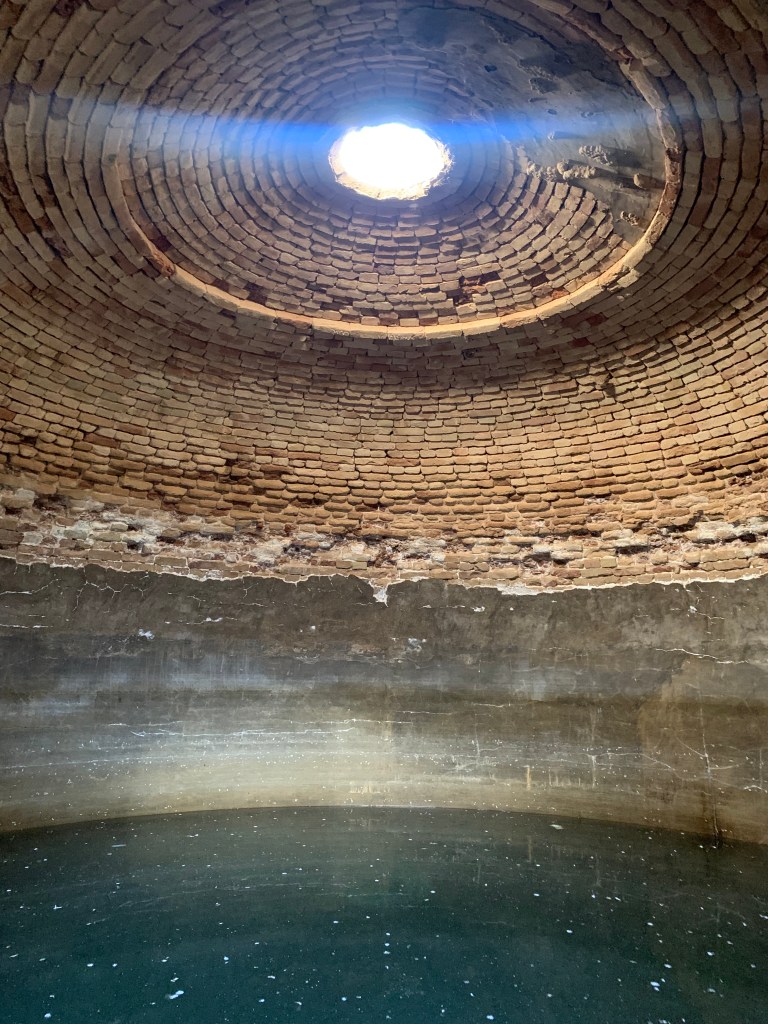
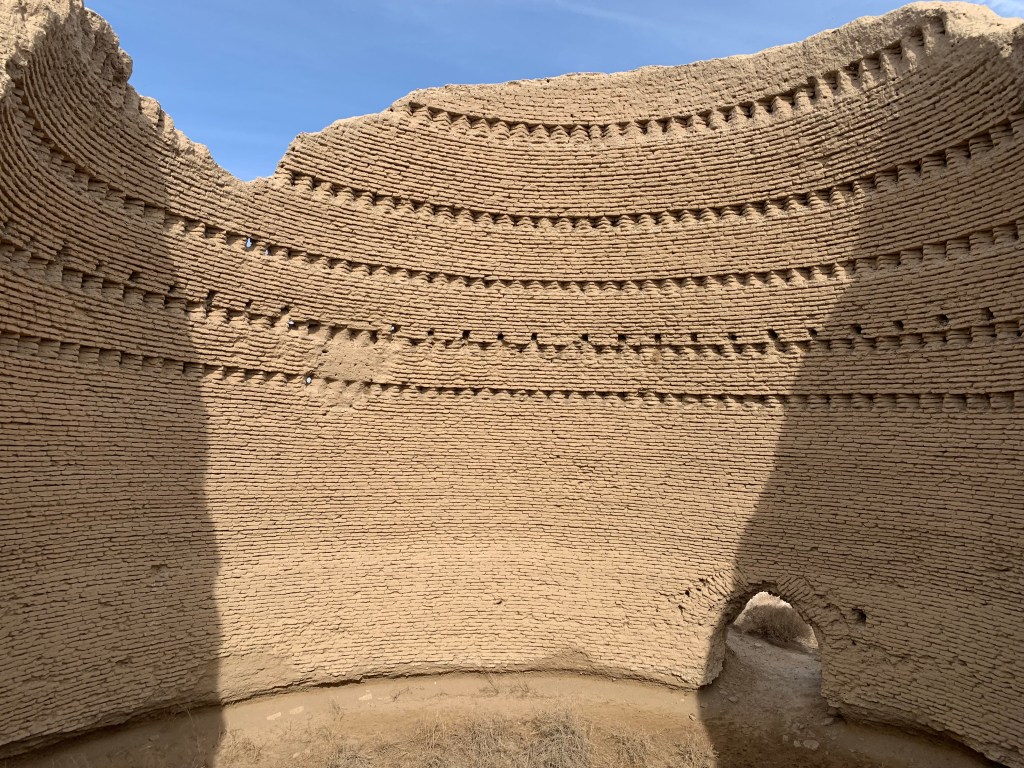
The ancient Merw did not disappoint. It used to cover some 1000 hectares and was the largest city in the world at its peak – 1/2 million people lived there. The conquerors and emperors came and took and destroyed and rebuilt. The far stretching walls, some fortresses and Ice houses still stand. And the camels graze where the merchants traded and the caravanserais stood.
Reading The 1001 Nights, stories of Sheherazade, in my early teens, has planted the germ of desire to visit Samarkand, Bokhara, Khiva…
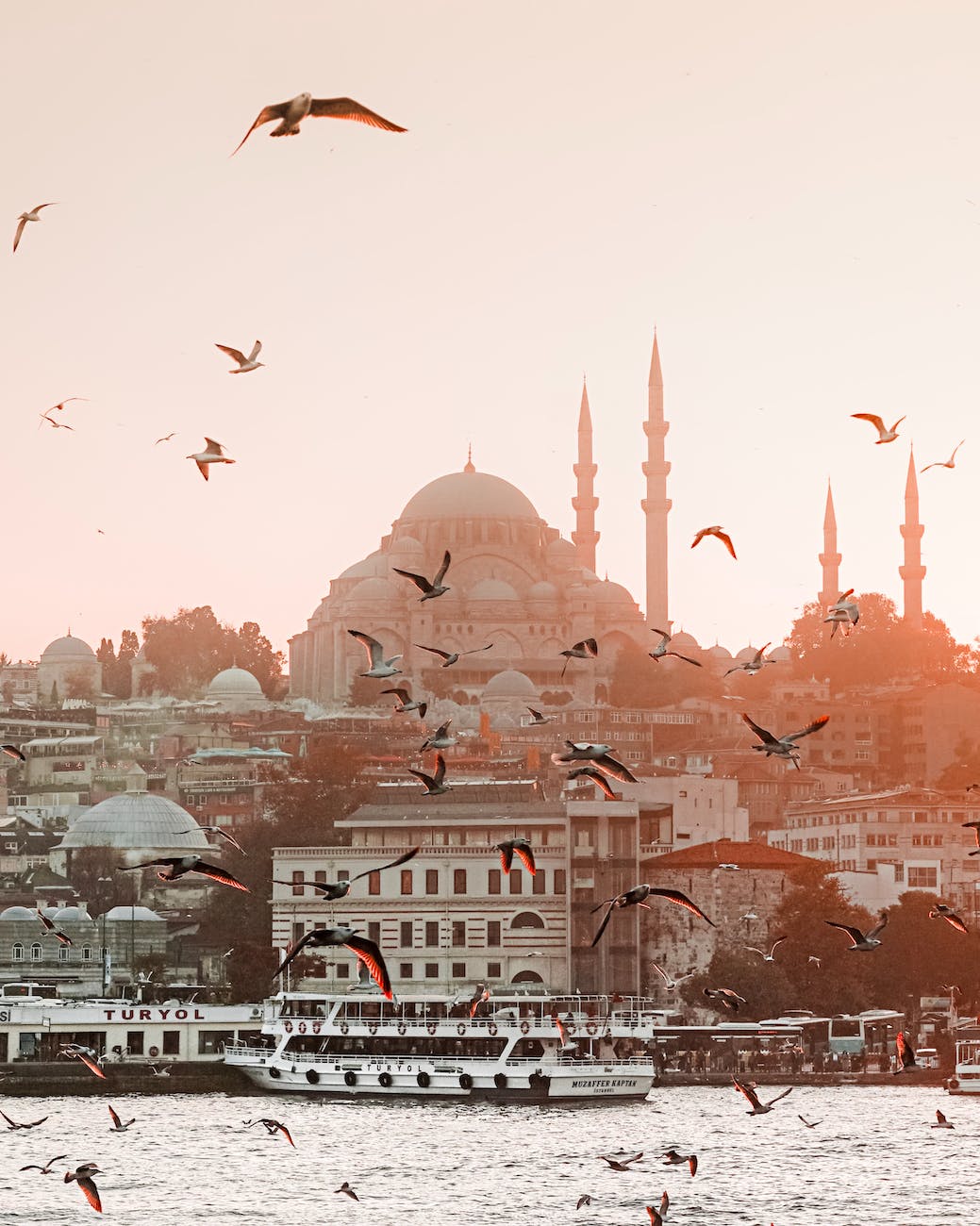
It has taken almost 60 years to get to the point where planning and actual travelling is taking place, but I AM DOING IT. The start is the flight to Istanbul on 9 October 2023. simply because I have not visited there before – and Turkey is a part of the Old Silk Road. I’m doing it “backwards”, going west to east, and very much looking forward to unpicking the way. I want to avoid air travel as much as possible, so road and rail (and camel?) will be it. October should be a lot quieter than the summer months – especially in places like Pammukale and Cappadocia, Ephesus and Hierapolis, Kanya and Kars. The trip is very fluid – out of the 6 months earmarked for the journey, nothing booked beyond the homestay in Istanbul for 6 days…
Should someone wish to join me at any point, for any length of time, I would welcome it.
The blog seems like a good place to let those who wish to know where I am – and how I’m faring. I look forward to a true adventure, and sharing it.






 Maribibi_travels